
Introduction
Ecommerce search is evolving beyond the traditional search results page. Google and other search platforms remain important sources of product discovery, but AI-powered search is changing how shoppers find information, compare products and make purchasing decisions.
Instead of searching with a short phrase and visiting several websites, consumers can increasingly describe their requirements in natural language. An AI-powered search experience can then interpret those requirements and produce a response that combines information from different sources.
For ecommerce brands, this creates a new consideration around how product information is written, organised and presented. Generative Engine Optimisation (GEO) focuses on making content easier for AI-powered search systems to understand and use. For online retailers, that means going beyond basic keyword optimisation and developing product content that provides clear facts, useful context and genuine answers to purchasing questions.
The fundamentals of good SEO still matter. What is changing is the number of ways in which that information can be discovered and interpreted.
The Rise of Generative Search
Traditional search has generally worked by matching queries with relevant webpages and presenting those pages in a set of results. Generative search introduces another layer, where systems can interpret information from multiple sources and formulate an answer. This is particularly relevant to ecommerce because shopping decisions often involve several related questions.
A search for a winter jacket might involve requirements around waterproofing, insulation, weight, price and intended activity. A shopper may previously have searched for each characteristic separately. With a generative interface, those requirements can be combined into one detailed request. That changes the importance of contextual product information.
From Keywords to Context
A product page that only identifies an item and lists a handful of features gives search systems relatively little information about its wider relevance. A detailed page can explain the intended use of the product, its materials, specifications, compatibility, limitations and the types of customers it is designed to serve.
This additional context can help connect a product with more specific search intent. It also creates a better experience for shoppers. Someone researching an unfamiliar product category often needs more than a product name before making a decision.
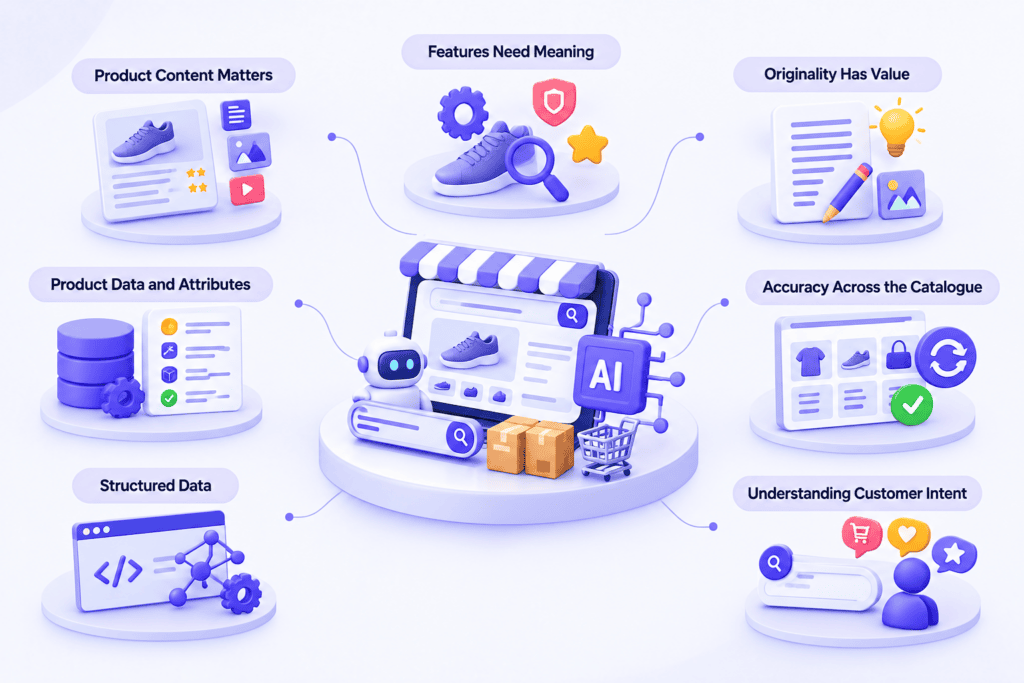
Product Content Matters
Product descriptions are among the most important pieces of content on an ecommerce website, yet they are frequently underdeveloped. Many retailers use manufacturer descriptions with little original information. Others rely on short paragraphs that contain a product name, a few features and generic promotional language.
Such descriptions may identify the product, but they rarely explain it in enough depth. Effective ecommerce content should establish what a product is, how it works, what makes it different and where it is most useful. The amount of detail required will naturally vary between categories.
Features Need Meaning
A list of specifications can be useful, particularly for technically minded shoppers, but specifications alone do not always explain the practical value of a product. A laptop’s processor, RAM and battery capacity are important facts. Information about whether the machine is intended for everyday office work, creative applications or frequent travel gives those specifications more context.
The same principle applies to less technical products. A coat can list its fabric composition and waterproof rating while also explaining the conditions it is designed for. A mattress can describe its construction and firmness alongside information about sleeping positions and support. The result is content that explains the product rather than simply naming its characteristics.
Originality Has Value
Original product information also helps distinguish an ecommerce website from retailers using the same manufacturer copy. This does not mean every description needs to be dramatically longer. It means the page should contain information that is genuinely useful and relevant to the particular product.
Specific details are usually more valuable than generic claims about quality. Statements such as “premium design”, “excellent performance” and “perfect for modern lifestyles” could describe almost any product. Information about materials, dimensions, intended applications, compatibility or maintenance provides far more substance.
Product Data and Attributes
Written descriptions are only one part of an ecommerce product page. Product data can include hundreds of individual attributes, from colour and size to materials, dimensions, technical specifications and compatibility. For large catalogues, this information can form an important part of how products are understood.
A well-structured catalogue allows these details to be managed consistently across product pages, category pages, filters and feeds. Poor catalogue data creates the opposite problem. If a product has incomplete specifications, inconsistent naming or inaccurate availability information, the website becomes a less reliable source of information.
Accuracy Across the Catalogue
Ecommerce data changes constantly. Products go out of stock, prices are updated, new variants are introduced and specifications can change. These updates need to be reflected wherever the information appears.
For a small catalogue, this may be manageable manually. For a large ecommerce operation, reliable processes and automation become increasingly important. Automation, however, is only as effective as the data behind it. A system that distributes incorrect information simply spreads the error across more channels.
Product Feeds
Product feeds add another layer to this process. Shopping platforms and other discovery services can use feeds containing product names, prices, availability and other catalogue information. Accurate feeds therefore form part of a broader ecommerce visibility strategy.
Keeping website data and feed data aligned reduces the risk of contradictory information appearing across different platforms.
Structured Data
Structured data gives search engines information in a machine-readable format. For ecommerce websites, product-related structured data can communicate details associated with products, offers and availability. This can help search engines understand the information presented on a page.
Structured data is not a direct guarantee of rankings or inclusion in an AI-generated response. Its value lies in providing clear information about the content of the page. This becomes particularly important on large ecommerce websites, where thousands of products and variants need to be interpreted consistently.
Handling Variants
Configurable and variant-based products can make structured data more complicated. A product may have different prices, colours, sizes or availability depending on the selected option. The information supplied to search engines needs to correspond with the actual product and offer available to customers.
This requires more than adding a generic schema template to every page. Magento and Adobe Commerce stores with complex catalogues should pay particular attention to how product attributes, variants and structured data interact.
Understanding Customer Intent
One of the biggest differences between traditional keyword-focused optimisation and generative search is the amount of context contained within a query. Consumers increasingly have the ability to describe a situation rather than simply name a product.
A shopper may not be looking for an “office chair” in isolation. They may be looking for a chair suitable for extended desk work, a smaller workspace and a particular budget. The more specific the request becomes, the more useful detailed product information becomes.
Questions Behind the Search
Every product category has recurring questions that influence purchasing decisions. Clothing shoppers may need information about fit and fabric care. Technology buyers may want to know about compatibility and connectivity. Furniture customers may care about dimensions, assembly and materials.
These questions reveal the information that product pages need to communicate. Instead of treating them as separate SEO keywords, they can be incorporated naturally into descriptions, specifications, FAQs and supporting content.
Informational Intent
Not every search is immediately commercial. A consumer may begin by researching a product category before deciding what to buy. Informational content can therefore play an important role in the path towards a purchase.
Guides, comparisons and explanatory articles can provide the background information needed before a shopper reaches a product page.
FAQs and Buying Questions
Frequently asked questions can provide useful additional information when they address genuine customer concerns. An FAQ should not exist simply to create more text on a page. Its purpose is to answer questions that might otherwise prevent a customer from understanding or purchasing a product.
Questions about sizing, compatibility, installation, maintenance and suitability are often more valuable than artificial variations of the main keyword.
Use Real Customer Questions
Customer service enquiries are an excellent source of potential FAQ topics. Sales teams and support staff regularly encounter questions that do not appear in keyword research tools. Product reviews can reveal similar information gaps.
Onsite search data can also show what customers are trying to find after arriving on the website. Turning these recurring questions into useful content can strengthen the overall information available around a product.
The Value of Reviews
Customer reviews provide a form of product information that businesses cannot replicate through standard marketing copy. A brand can explain what a product is designed to do, while customers can describe what it is actually like to use.
Reviews may discuss fit, comfort, durability, ease of installation, quality or performance. They can also introduce terminology that customers naturally use when discussing the product. This creates additional context around the product page.
Authenticity Over Optimisation
The value of reviews depends on their authenticity. Creating artificial reviews or attempting to manipulate customer language for search purposes removes the very quality that makes reviews useful.
Genuine feedback can reveal strengths, weaknesses and use cases that may not have been considered in the original product description. For ecommerce brands, encouraging honest customer feedback is therefore valuable for reasons that extend well beyond search optimisation.
Supporting Content
A product page cannot realistically answer every question about a category. Supporting content provides space for broader topics while allowing product pages to remain focused on the individual items being sold.
An outdoor retailer might publish articles about choosing equipment, preparing for different conditions and maintaining products. A technology retailer could cover compatibility, buying considerations and differences between product types. These resources can then connect naturally to commercial pages.
Building Topical Depth
The strongest supporting content has a clear relationship with the catalogue. A guide to choosing running shoes can link to running shoe categories. An article about mattress firmness can connect to mattress collections. A comparison of laptop specifications can direct readers towards relevant products.
This creates a connected information structure. It also gives the website an opportunity to demonstrate knowledge beyond individual product descriptions.
Avoiding Content for Content’s Sake
The growth of AI search should not lead to an endless stream of generic articles. Publishing dozens of loosely related posts may increase the size of a website without improving its usefulness.
Supporting content should exist because it answers a meaningful question, explains a complicated topic or helps customers make a better purchasing decision. Quality and relevance matter more than volume.
Category Pages
Category pages sit between individual products and broader informational content. They can introduce a product type, explain important differences and help shoppers understand the options available.
A category page containing only a product grid provides limited context. A page with concise, relevant information can serve both the shopping experience and organic discovery.
Useful Category Copy
The content should match the category. A running footwear page might explain differences between road and trail shoes. A furniture category might cover materials, dimensions and room suitability. A laptop category might discuss screen sizes, operating systems and typical usage.
The purpose is not to turn category pages into lengthy articles. Short sections of genuinely useful information can provide sufficient context while keeping the products at the centre of the page.
Internal Linking
Ecommerce websites contain several different types of content, and internal links help connect them. A buying guide can link to a relevant category. A category can connect to important products. Related products can link to one another where the relationship is useful.
These connections help establish the structure of the website. They also make it easier for search engines to discover related content and understand the relationships between informational and commercial pages. A strong internal linking strategy therefore supports both conventional SEO and the broader information architecture needed for ecommerce GEO.
GEO for Magento
Magento and Adobe Commerce are particularly relevant to GEO because they are designed to manage large and complex product catalogues. The platform supports extensive product attributes, configurable products, multiple categories and sophisticated catalogue structures. A well-structured Magento development approach can help ecommerce businesses manage product data, content and technical foundations in a way that supports both traditional and AI-powered search.
That creates opportunities for detailed product information, but it also creates a need for disciplined data management. A store with thousands of products cannot depend entirely on manually written content.
Product Attributes at Scale
Attributes such as colour, material, size, brand, dimensions and compatibility can provide valuable structured information. When these attributes are properly maintained, they can support product pages, filters, category experiences and catalogue feeds.
The quality of this underlying information can have a significant impact on the overall usefulness of the ecommerce website.
Templates and Automation
Magento’s templating and catalogue capabilities can help distribute consistent information across large numbers of products.
Automation can handle repetitive elements, while editorial content can focus on areas where additional context is genuinely needed. This creates a more scalable approach than attempting to write thousands of lengthy descriptions individually.
Technical SEO Still Matters
GEO does not eliminate technical SEO. AI systems still need to discover, access and interpret webpages. If important product pages are blocked from crawling, incorrectly canonicalised or difficult to discover through internal links, content quality alone cannot solve the underlying problem.
Large ecommerce websites also need to manage faceted navigation, duplicate URLs and parameter-based pages carefully.
Crawlability and Indexation
Filters and sorting functions can generate large numbers of URL variations. Without an appropriate technical strategy, these URLs can consume crawl resources and make it harder for search engines to identify the pages that matter.
Clear canonicalisation, sensible internal linking and appropriate indexation controls help maintain a cleaner ecommerce architecture.
Site Performance
Ecommerce websites often contain large images, JavaScript applications, third-party scripts and complex functionality. Performance therefore remains an important consideration.
A fast and accessible product page provides a better experience for shoppers and creates a stronger technical foundation for search visibility.
AI-Generated Content
The emergence of GEO has naturally increased the use of AI for ecommerce content production. AI can help with research, organisation, first drafts and content workflows. It should not, however, be treated as a substitute for product knowledge.
Automatically generating thousands of near-identical descriptions can create a catalogue full of content without meaningful differentiation.
Specificity Wins
Strong ecommerce copy contains information that cannot be easily substituted. Materials, measurements, compatibility details, intended applications and product limitations are useful because they describe the actual item.
Generic statements about quality provide little additional information. The same principle applies to supporting articles. An article based on genuine product expertise will generally provide more value than a generic piece assembled around a list of related keywords.
Measuring GEO
GEO measurement is still developing. Traditional SEO provides established metrics such as impressions, rankings, clicks and conversions. Generative search can be more difficult to measure because the process by which information is selected and presented is not always transparent.
This makes it difficult to reduce GEO to a single ranking position. Organic performance remains useful, alongside branded search activity, referral traffic, engagement and ecommerce conversions. As generative search platforms develop their reporting capabilities, the way GEO performance is measured is likely to become clearer.
A Long-Term Strategy
GEO should be considered part of an ongoing ecommerce content strategy rather than a one-off optimisation exercise. Product information changes. New products are added. Existing products are discontinued. Prices and stock levels change. Search technology evolves alongside these changes.
Regular reviews can help ensure that important product and category pages remain accurate and useful. For large Magento and Adobe Commerce stores, scalable processes are especially important. The objective is to build systems that maintain quality across the catalogue rather than relying solely on manual optimisation.
Final Thoughts: The Future of Ecommerce Search
The ecommerce search journey is becoming more complex, but the fundamentals remain familiar. Customers still need accurate information. They still need clear product comparisons. They still need answers to questions about suitability, quality, price and performance.
What is changing is the way that information can be discovered and presented. AI assistants and generative search experiences can interpret longer queries, combine information from different sources and provide answers without requiring users to visit several websites first.
That makes the quality of ecommerce information increasingly important. GEO is therefore not about producing content exclusively for machines. It is about creating a clearer, more complete digital representation of the products and expertise held by an ecommerce business.
For Magento and Adobe Commerce stores in particular, strong product data, detailed catalogue structures, technically sound pages and useful supporting content can provide a solid foundation for this evolving search environment.


 Tom
Tom