
Introduction
Search is changing. For years, businesses have built their online visibility around traditional search engines, with SEO strategies focused on keywords, rankings, backlinks, technical optimisation and content. A user would enter a query, scan through the results and visit different websites to find the information they needed. Today, that process is becoming increasingly conversational. People can ask AI platforms such as ChatGPT, Gemini and Perplexity detailed questions and receive answers that bring together information from multiple sources.
In this guide, we’ll look at what LLM SEO means, how Large Language Models understand information, what role NLP plays in modern search and why businesses need to start thinking about content in terms of meaning and context rather than keywords alone.
What Is LLM SEO?
LLM SEO refers to the process of optimising website content so that Large Language Models and AI-powered search systems can more easily understand, interpret and potentially retrieve information from it. The concept is closely connected to traditional SEO, but the focus extends beyond simply helping a webpage rank for a keyword.
Traditional SEO asks questions such as whether a page is relevant to a search query, whether search engines can crawl and index it, whether the content satisfies search intent and whether the website has enough authority to compete. LLM SEO adds another question to that process: can an AI system clearly understand the information contained on the page?
The focus is on meaning rather than repetition: Keywords still matter, but modern AI systems can understand far more than exact keyword matches. A page can discuss a subject using related terminology, concepts and natural language while still remaining highly relevant to the main topic. This means content should be written to explain an idea properly rather than forcing the same keyword into every paragraph.
Context gives content its meaning: A single word can have multiple meanings depending on the information surrounding it. When a page provides enough context, an AI system has more information to determine what the author is actually talking about. This is particularly important for businesses, products, technologies and technical subjects that can have multiple interpretations.
What Is LLMO?
LLMO stands for Large Language Model Optimisation. The term is often used alongside LLM SEO to describe the process of improving digital content and information so that Large Language Models can understand and potentially use it more effectively.
There isn’t one universally accepted definition of LLMO because AI search is still developing and different marketers use the terminology slightly differently. In practical terms, however, both LLM SEO and LLMO are concerned with the same fundamental challenge: making information clear and understandable to AI systems.
LLMO is broader than keyword optimisation: Instead of focusing only on phrases people type into search engines, LLMO considers how information is structured, how entities are represented, how concepts relate to each other and whether important information can be clearly understood when retrieved.
The objective isn’t to “hack” AI: There is no reliable trick that guarantees ChatGPT, Gemini or another AI system will mention your company. LLMO should instead focus on making your website a useful, credible and understandable source of information.
Why Context Is So Important for AI Search
Traditional search has already moved well beyond simple keyword matching. Modern search systems can interpret queries, understand relationships between concepts and evaluate whether content satisfies the underlying intent of a search.
Cover the wider topic: If your page targets a specific subject, identify the concepts that naturally belong to that subject. A comprehensive page about Magento performance might discuss caching, image optimisation, server response time, JavaScript, extensions, database performance and Core Web Vitals because these concepts help explain the broader topic.
Answer the questions surrounding the topic: People rarely want just a definition. They usually have a problem they are trying to solve. Understanding the questions that follow your primary topic can help you create content that is genuinely useful.
What Is Natural Language Processing?
Natural Language Processing, or NLP, is a branch of artificial intelligence that focuses on helping computers process, understand and work with human language.
Humans are very good at understanding different ways of expressing the same idea. Someone might ask, “How can I make my website faster?” while another person asks, “What can I do to improve my website’s loading speed?” The wording is different, but the underlying intent is similar.
NLP helps machines identify relationships used across many technologies, including search engines, chatbots, translation tools, voice assistants and generative AI. NLP allows systems to analyse language and work with elements such as words, phrases, meaning, intent and context.
For SEO, this is particularly important because users don’t always search using the exact terminology found on a webpage.
A user may search for “online shop website,” while another searches for “ecommerce website.” They may be looking for essentially the same type of solution. A search system capable of understanding language can recognise that relationship rather than treating the two phrases as completely unrelated.
Search Intent and LLMs
Search intent refers to the reason behind a user’s search. Two people can use similar keywords while looking for completely different things, which is why understanding intent is such an important part of SEO.
For example, someone searching for “Magento development” might be researching what Magento development means. Another person might be looking for a Magento development agency. Someone else might be comparing Magento with Shopify before deciding which platform to use.
- Informational intent: The user wants to learn something. These searches are usually best answered with educational guides, explanations, tutorials and detailed resources that help the reader understand a subject.
- Commercial investigation: The user is researching a potential purchase or service. Content should help them compare options, understand benefits and limitations, and determine which solution may be appropriate for their situation.
- Transactional intent: The user is ready to take action. Service pages, product pages and conversion-focused landing pages are designed for these searches and should make the offering, value and next steps clear.
Understanding these different intents helps you create content that answers the actual question rather than simply matching the words used in the search.
Why LLM SEO Matters
The importance of LLM SEO comes from the way people are beginning to discover information.
Instead of searching for a keyword, opening several results and comparing them manually, users can ask an AI system to research a topic for them. They may ask for recommendations, comparisons, explanations or solutions to specific problems.
For businesses, this introduces another layer of search visibility.
Instead, LLM SEO should be viewed as an extension of modern SEO.
- Traditional SEO helps people discover your website: Technical accessibility, crawlability, content quality, internal linking and authority remain important because search systems still need to find and evaluate your information.
- LLM SEO helps make your information understandable: Clear explanations, strong context, entity relationships and useful content can make it easier for AI systems to interpret what your website is about.
- Both strategies work together: The strongest approach isn’t choosing between traditional SEO and LLM SEO. It is building a technically sound website with authoritative content that communicates its information clearly to both search engines and AI systems.
How to Optimise Your Website for LLMs
Build Topical Authority Through Connected Content
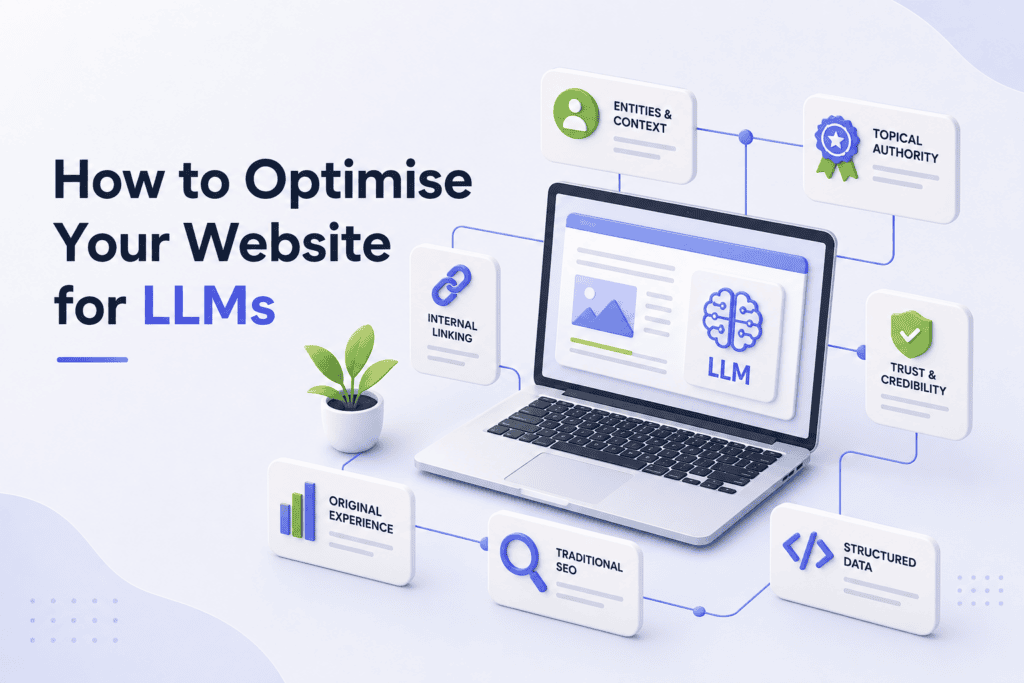
One article can explain a topic, but a group of related resources can demonstrate much greater depth. This is where topical authority becomes particularly useful for LLM SEO.
Imagine a website wants to establish expertise around AI search. Instead of publishing one article about LLM SEO and moving on to unrelated subjects, it could develop a connected library covering LLM SEO, LLMO, NLP, semantic SEO, AEO, GEO, AI Overviews, entity optimisation, structured data and AI search behaviour.
Each article can explain one specific area while linking to the others where relevant. Over time, the website develops a clear network of information around the broader subject.
Create supporting content: Once you have identified an important topic, look for related questions that deserve their own detailed resources. Don’t create supporting articles simply to increase the number of URLs; each page should provide genuinely useful information. Working on llm.txt file can also help in llm seo.
Connect related pages: Internal links should help readers move naturally between related subjects. If an article introduces NLP and you have a detailed NLP guide, link to it where the reader would benefit from more information.
Build depth instead of volume: Ten highly relevant articles covering a subject in depth can be more useful than fifty generic articles that barely touch on it. The objective is to create a strong information resource, not simply a large content library.
Use Entities to Give AI Systems More Context
Entities are an important part of how AI systems understand information. An entity can be a person, company, organisation, product, location or concept that can be clearly identified.
Keep business information consistent: Your company name, services, descriptions and other important details should be presented consistently across your website and other credible online sources. Inconsistent information can make it harder to establish a clear digital identity.
Explain relationships: Don’t just mention entities; explain how they relate to each other. If a company provides SEO services, for example, explain the connection between those services, the problems they solve and the industries or audiences they serve.
Create dedicated resources for important entities: If a subject is particularly important to your business, consider creating a detailed page that clearly explains it rather than mentioning it briefly across dozens of unrelated pages.
Strengthen Internal Linking
Internal linking has always been an important SEO practice, but it also helps create a clearer information structure across your website.
Link where there is genuine relevance: Don’t add internal links simply to increase the number of links on a page. Link when the destination provides additional information that is useful to the reader.
Use descriptive anchor text: The anchor should give the reader an idea of what they will find after clicking. This also provides additional context about the relationship between the two pages.
Connect your important pages: Your most valuable commercial and informational pages shouldn’t exist in isolation. Create relevant connections between them so users and search systems can discover the wider information available on your website.
Add Original Experience and Information
As AI makes content production easier, simply publishing information that already exists everywhere becomes less valuable. A large language model can generate a basic explanation of almost any common topic. Your website needs to offer something more.
Share first-hand experience: If your team has implemented a strategy, explain what you actually did and what you learned. Real experience provides context that generic articles often lack.
Publish original research: Surveys, experiments, testing and data analysis can create information that other websites don’t have. When presented clearly, this type of content can become a valuable reference.
Add expert commentary: Don’t be afraid to explain what you think about a subject. A useful expert perspective can make an article more distinctive, particularly when the topic is already heavily covered online.
Make Your Content Trustworthy
Understanding a topic is only one part of AI search. The quality and reliability of the information also matter.
When writing about technical or rapidly changing subjects such as AI, avoid presenting uncertain claims as established facts. If you reference research, statistics or specific developments, use credible sources and make it clear where the information comes from.
Your website should also make it easy for readers to understand who is behind the content. Clear author information, company details, relevant experience and links to supporting sources can all contribute to a stronger overall sense of credibility.
Trust isn’t created by adding a single “expert” badge to a page. It comes from the combination of accurate information, transparent authorship, genuine experience and consistency across your website.
Don’t Forget Traditional SEO
LLM SEO doesn’t mean abandoning everything you’ve learned about traditional SEO.
A website still needs to be crawlable. Search engines and other systems still need to discover its pages. Content still needs to satisfy users. Internal links still matter. Website performance and accessibility still matter. Authority still matters.
The difference is that you now need to consider another layer of discovery.
A useful way to think about it is that traditional SEO helps search systems discover and evaluate your website, while LLM SEO focuses more heavily on how clearly the information can be understood and used within AI-powered experiences.
The two strategies work best together.
A technically excellent website with poor content won’t become a strong AI source simply because it has good Core Web Vitals. Likewise, an incredibly useful article won’t perform well if search engines cannot properly access or understand the page.
A strong foundation is still essential.
Structured Data and AI Search
Structured data provides search engines with additional information about the content of a webpage. It uses a standard format to describe things such as products, organisations, articles, reviews, events and other types of information.
Use relevant schema: Only implement structured data that accurately represents the content on the page. Adding irrelevant schema simply because it is available doesn’t make the page more useful.
Keep structured data accurate: If your visible page says that a product is unavailable but your structured data says it is in stock, you are creating conflicting information. Your structured data should reflect what users can actually see on the page.
Treat structured data as supporting information: Schema should complement good content and technical SEO rather than replace them. A page still needs useful information, clear structure and a strong user experience.
LLM SEO vs Traditional SEO
LLM SEO and traditional SEO shouldn’t be treated as two completely separate marketing strategies. They overlap heavily because both depend on useful content, technical accessibility, relevance, authority and a good user experience.
Traditional search typically presents users with a list of results. AI search can provide a direct answer that combines information from different sources. This means businesses need to think about not only whether their page can be discovered but also whether the information on that page is clear enough to be understood and potentially included within a generated response.
| Traditional SEO | LLM SEO |
| Focuses heavily on search rankings | Focuses on AI visibility and information retrieval |
| Targets keywords and search queries | Focuses more heavily on topics, context and meaning |
| Optimises pages for search engines and users | Optimises information for users and language models |
| Measures rankings, clicks and organic traffic | Can include mentions, citations, AI referrals and conversions |
| Builds authority through links and quality signals | Builds authority through expertise, useful information and strong entity signals |
| Primarily works around search results | Extends into conversational and AI-generated answers |
How LLM SEO Can Help Ecommerce Businesses
For ecommerce businesses, AI search could influence several stages of the buying journey. A customer might use AI to discover products, compare platforms, understand product features, find solutions to a problem or identify businesses that provide a particular service.
This makes informational content particularly valuable.
A store selling ecommerce technology services, for example, could publish detailed resources explaining platform comparisons, migration considerations, ecommerce performance, integrations and customisation. These resources can answer questions that customers have before they ever contact the company.
For Kiwi Commerce, this approach is particularly relevant because ecommerce development involves complex decisions. A potential customer may not initially search for a specific development agency. They might first search for information about Magento, Shopify, migration, ecommerce performance or custom functionality. Educational content can help the business become visible much earlier in that journey.
Build around customer problems: Instead of creating content only around your services, consider the problems that cause customers to look for those services in the first place.
Connect informational and commercial content: A useful guide should naturally lead readers to relevant services when those services provide the next logical step.
Demonstrate technical expertise: Ecommerce development is technical, so detailed explanations, case studies and practical examples can help establish the depth of your knowledge.
The Future of LLM SEO
- Focus on information quality: Algorithms will change, but useful information will remain useful. Prioritise accurate, original and well-researched content.
- Build a recognisable digital identity: Make it clear who your business is, what it does and what subjects it has expertise in. Consistency across your website and wider digital presence can strengthen this identity.
- Keep improving existing content: LLM SEO isn’t only about publishing new articles. Updating outdated information, improving explanations and filling content gaps can make your existing resources more valuable.
- Don’t chase every AI trend: New terminology and optimisation techniques will appear constantly. Focus on principles that are likely to remain useful: relevance, clarity, expertise, accessibility and trust.
Final Thoughts
LLM SEO represents a significant evolution in how businesses should think about search visibility. Traditional SEO taught businesses to optimise pages for search engines and users. AI search adds another layer by requiring businesses to consider how clearly their information can be understood by systems that process language and generate answers.
Large Language Models and Natural Language Processing allow AI systems to understand relationships between words, concepts and questions in ways that go far beyond simple keyword matching. As a result, businesses need to think about topics, context, entities, intent and information quality.
The answer isn’t to abandon traditional SEO or fill your website with AI-generated content. The better approach is to build a website that is technically accessible, logically structured, rich in useful information and backed by genuine expertise.
For ecommerce businesses, this can mean creating better product and service pages, developing comprehensive guides, strengthening internal links and publishing content that answers the questions customers have throughout their buying journey.
The future of search belongs to businesses that can communicate their expertise clearly. If your website can provide useful answers to real questions, explain complex subjects simply and establish a strong connection between your brand and the topics you specialise in, you’re building an SEO foundation that can work across both traditional and AI-powered search.


 Tom
Tom