
Introduction
BigCommerce is a cloud-based eCommerce platform that enables companies to create and manage an online store without having to worry about hosting, servers, or software updates. BigCommerce manages the infrastructure while you pay a monthly subscription and concentrate on selling.
That’s the straightforward response. Whether BigCommerce is truly the best platform for your particular business will determine the more helpful response, which is covered in this article.
What is BigCommerce?
One type of SaaS (Software as a Service) eCommerce platform is BigCommerce. It is not downloaded or installed by you. You register, select a plan, and use a browser to visit your store. BigCommerce’s admin dashboard controls everything, including your product listings, theme, checkout, and orders.
Eddie Machalaani and Mitch Harper established it, and it debuted in Sydney, Australia, in 2009. These days, it helps companies with hundreds of thousands of products and intricate B2B operations, from small online merchants to major corporate brands.
BigCommerce’s main selling point is that it takes care of eCommerce’s technical complexity so you don’t have to. No manual software upgrades, security patches, or server maintenance. You work inside BigCommerce’s architecture in exchange. Less technical control comes at the expense of much lower technical overhead.
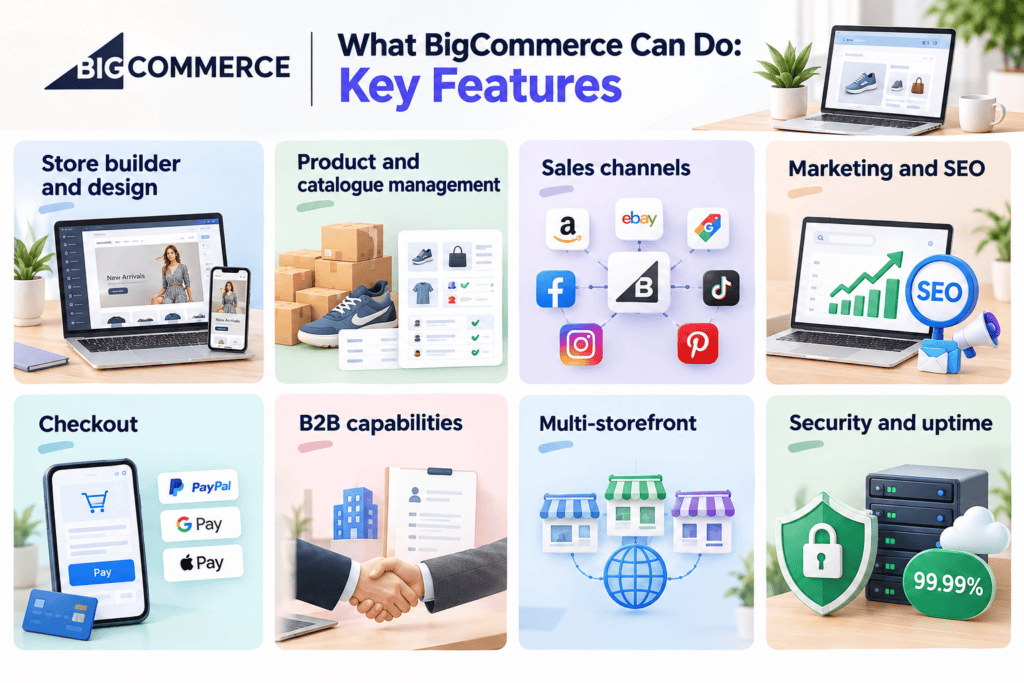
What BigCommerce Can Do: Key Features
Store builder and design
BigCommerce comes with a drag-and-drop page builder that allows you to create and modify store pages without knowing any code. Based on its Stencil framework, it provides both premium and free themes. Every theme is responsive; it instantly adjusts to desktop and mobile screens.
BigCommerce’s GraphQL API allows for headless commerce and full custom theme development via Stencil, allowing developers to build the shopfront entirely independently of the backend using React or any other contemporary framework.
Product and catalogue management
BigCommerce manages an infinite number of goods, categories, and variations across all plans. Each product may have up to 600 variations. Through third-party connections, it supports subscriptions, physical goods, and digital goods.
Without the need for extra software, inventory management is integrated; you can monitor stock levels, set low-stock alerts, and manage products across several locations.
Sales channels
BigCommerce offers direct connections from the admin to Amazon, eBay, Google Shopping, Facebook, Instagram, TikTok, and Pinterest in addition to your own business. The entry-level package offers this multi-channel selling without the need for additional apps.
Marketing and SEO
You have control over canonical tags, page titles, meta descriptions, and URL architectures with BigCommerce. It allows 301 redirects without the need for plugins and automatically creates structured data for products. Its default SEO configuration is significantly more developer-friendly than that of certain SaaS eCommerce platforms.
In terms of promotion, there are built-in discount coupons, gift cards, product reviews with ratings, a native blog, and email sequences about abandoned carts (starting with the Plus package). Additionally, via its app marketplace, it links to email marketing systems like Klaviyo, Mailchimp, and Omnisend.
Checkout
By default, BigCommerce employs a one-page checkout. PayPal, Google Pay, and Apple Pay are all supported right out of the box. It links to more than 65 payment gateways worldwide and only uses the gateway’s regular processing rate; it does not impose its own transaction fees on any plan.
B2B capabilities
The B2B Edition of BigCommerce significantly sets itself apart from Shopify. Without requiring extensive custom programming, it provides corporate accounts, buyer roles and permissions, quote administration, configurable price lists per account, net payment terms (net 30, 60, 90), and a self-service buyer portal.
The native B2B feature set is far more advanced than what Shopify provides by default for wholesale and trade companies that require distinct pricing, ordering procedures, and account hierarchies for various buyers.
Multi-storefront
BigCommerce’s Standard plan enables several shopfronts, distinct branded stores that target various consumer segments, geographical areas, or languages, all under the control of a single administrator. This functionality makes BigCommerce significantly less expensive at scale for multi-brand or multi-region operations by requiring a new Shopify Plus store for each shopfront on Shopify.
Security and uptime
The highest level of payment security certification, PCI DSS Level 1, is met by BigCommerce. All plans come with SSL certificates. The infrastructure adapts automatically for traffic spikes, including peak selling events, without the need for human intervention, and uptime is contractually guarantyd at 99.99%.
BigCommerce Pricing Plans
BigCommerce sets rates according to subscription tiers, with a yearly sales cap for each tier. Your plan will automatically upgrade to the next tier if you exceed the cap. The prices shown below are all monthly billing rates; annual billing results in a 25% cost savings.
Standard — $39/month
For companies with yearly internet sales of up to $50,000. features a single-page checkout, Apple Pay and Google Pay, an infinite number of products, all sales channels, real-time shipping quotes, and expert reporting. This plan does not include phone support.
Plus — $105/month
For companies with yearly sales of up to $180,000. adds a persistent cart, customer groups and segmentation, stored credit cards, and an abandoned cart saver. Just the abandoned cart function, which re-engages clients who left without completing a transaction, has commercial significance.
Pro — $399/month
For companies with yearly sales up to $400,000, plus an extra $150 per month for every $200,000 over that amount. increases the API rate limit for third-party integrations and incorporates Google Customer Reviews.
Enterprise — Custom pricing
For companies with complicated requirements or those with large volumes. Although real cost is negotiated directly with BigCommerce, published starting prices from multiple sources suggest starting at about $1,499/month. increases API capacity, price-locked assurances, specialised account management, priority support, and sophisticated security controls. There is no GMV cap.
A note on the sales caps
Before you sign up, it’s important to understand the plan tier system. BigCommerce keeps track of your yearly sales and, if you over the threshold, automatically advances you to the next plan. This is an automatic trigger rather than a manual one. Budget for the next tier before you reach the cap, not after, if your company is expanding quickly.
What BigCommerce Does Not Do Well
Every platform guide should tell you this. Most do not.
Customisation depth is limited compared to open-source platforms.
Many common eCommerce needs are met by BigCommerce’s admin settings and theme system. You will either need to create custom apps or discover that BigCommerce’s closed architecture cannot support your needs without major workarounds if your company requires highly customised backend logic, intricate product configurators, unique B2B pricing rules, multi-warehouse inventory routing, or custom customer account workflows that go beyond the platform’s built-in B2B edition.
The app ecosystem is smaller than Shopify’s.
Although it offers less third-party connectors than Shopify, BigCommerce’s app store is still rather good. Make sure the integration is available before committing if you depend on a particular speciality product, such as an industry-specific ERP, a specialised loyalty platform, or a local shipping company.
The revenue-based plan tiers can become expensive as you scale.
At $399 a month, the Pro plan is affordable for a company with annual sales close to $400,000. You are paying $399 + $150 = $549 per month at $600,000 in sales. $699 a month at $800,000. Although the model is transparent, rapidly expanding companies may find that costs are rising at a rate that diminishes the platform’s cost advantage.
BigCommerce is not the best fit for content-first or hybrid businesses.
BigCommerce’s CMS features are useful but constrained if the eCommerce operation is accompanied by substantial editorial content publication, media, and community. This is resolved by a headless solution that links BigCommerce to a specialised CMS (Contentful, Sanity, Storyblok), however it increases development expenses and complexity.
BigCommerce vs Shopify
These two platforms compete for the same core audience: medium-to-large online retailers who want a managed SaaS eCommerce platform without the infrastructure overhead of Magento.
The practical differences come down to a few specific points.
Built-in features vs app ecosystem:
Standard client groups, native multi-currency, multi-storefront, B2B tools, and sophisticated SEO configuration are just a few of the things that BigCommerce offers. Many of the same features are available through Shopify’s app store, which requires purchasing extra apps. BigCommerce’s strategy lowers potential monthly expenses and app dependency. With Shopify’s strategy, you have more options in the ecosystem.
Transaction fees:
On all plans, BigCommerce does not impose platform transaction fees. Unless you utilise Shopify Payments, Shopify charges 0.5%–2% for plans lower than Shopify Plus. For companies that use third-party payment gateways, especially for BNPL providers or overseas payments At volume, BigCommerce’s no-fee business model can result in significant cost savings.
B2B:
Compared to Shopify’s regular B2B capabilities, BigCommerce’s native B2B Edition is more advanced. BigCommerce requires less custom programming to get the same results for company accounts, net payment terms, buyer portals, and custom pricing lists for real wholesale operations.
Ease of use:
Shopify is generally regarded as easier to use for non-technical merchants, particularly those setting up their first store. Its admin interface is more consistently polished, the theme marketplace is larger, and the setup experience is more guided. If technical ease is the primary consideration and your requirements are standard, Shopify is a reasonable choice.
For a detailed enterprise-level comparison, our Shopify Plus vs BigCommerce guide covers the two platforms at scale.
BigCommerce vs Magento
These two platforms serve different audiences, and the comparison reflects that.
Hosted vs self-hosted:
BigCommerce is entirely hosted; you don’t have to worry about scalability, manage servers, or apply security fixes. You are in charge of the infrastructure whether Magento is self-hosted or cloud-hosted. Operational overhead is greatly decreased by BigCommerce’s managed model. You have complete control over every element of your environment thanks to Magento’s self-hosted approach.
Customisation:
Magento is available as open-source software. Any database structure, business logic, and core code can be altered to meet any requirements. BigCommerce follows a predetermined architecture. Businesses with very complicated requirements such as multi-warehouse inventories with custom routing logic, highly customised B2B workflows, or product configurators requiring custom backend computation are particularly affected by this distinction. BigCommerce frequently needs to design custom apps or is unable to support them at all; Magento manages these natively.
Cost model:
The monthly subscription fee for BigCommerce is predictable. The cost of hosting, development, maintenance, and extensions for Magento can be more than that of BigCommerce at comparable scale, albeit it varies greatly based on the team and hosting configuration.
Who should consider which:
BigCommerce is ideal for companies that emphasise controlled infrastructure, operate within traditional eCommerce patterns, and offload technological complexity. Magento is ideal for companies with particular, intricate needs that require enterprise B2B capability, multi-store operations, or platform customisation depth beyond what BigCommerce’s B2B Edition can provide.
Our Magento Development Services team works with merchants across both platforms and can advise on which is the right fit for a specific brief.
BigCommerce vs WooCommerce
WooCommerce is a free plugin for WordPress. BigCommerce is a standalone SaaS platform. The comparison works differently to BigCommerce vs Shopify or Magento.
Cost. Although WooCommerce is free, hosting, domains, security plugins, payment gateway extensions, and the time required to maintain a WordPress and WooCommerce installation are all included in the total cost of ownership. WooCommerce may be less expensive at low sales volumes. Costs converge at increasing quantities that call for improved hosting, performance work, and continuous maintenance.
Ease of scaling:
BigCommerce manages the infrastructure and automatically scales with your traffic. As WooCommerce grows, careful infrastructure choices must be made, including improved hosting, caching setup, and database optimisation. Developer input is necessary to do this right.
Content and flexibility:
BigCommerce manages the infrastructure and automatically scales with your traffic. WooCommerce on WordPress is a more natural design if you manage a content-first business with eCommerce as one component.
Who should consider which:
WooCommerce works well for companies who have a lot of content in addition to eCommerce or that are already involved in the WordPress ecosystem. BigCommerce is ideal for companies that prioritise eCommerce above managing WordPress and plugin compliance.
Is BigCommerce Right for Your Business?
Use this as a quick framework.
BigCommerce is worth serious consideration if:
- You want a managed SaaS platform with no server overhead
- Your B2B operation needs native wholesale, quote, and buyer account features without custom development
- You run or plan to run multiple storefronts for different brands or markets
- You want zero platform transaction fees without being locked into the platform’s own payment gateway
- Your annual revenue is below $400,000 and growing within a predictable trajectory
BigCommerce is probably not the right choice if:
- Your eCommerce requirements are highly bespoke and require deep platform customisation
- You need a very large third-party app ecosystem for niche integrations
- Your business is primarily content-driven with eCommerce as a secondary element
- You are already deeply invested in Magento infrastructure that is working well
Consider migrating away from BigCommerce to Magento if:
- Your operation has outgrown BigCommerce’s customisation ceiling
- You need multi-store management with shared catalogue logic across stores
- Your B2B requirements extend beyond what the B2B Edition covers natively
- You need open-source flexibility for custom modules, pricing logic, or integrations
Our BigCommerce to Magento Migration service is built specifically for businesses making this move, handling data transfer, URL redirect mapping, and integration rebuilding throughout the migration.
Need Help Choosing the Right Platform?
For the right company, BigCommerce is a reliable eCommerce platform. The KiwiCommerce team has certified expertise in both Magento and Shopify and can offer advice on the best platform for your particular needs if you’re a merchant thinking about using Magento, Shopify, or BigCommerce, or if you’ve outgrown BigCommerce and need to transition.
Get in touch with the KiwiCommerce team for a no-obligation conversation.


 Tom
Tom