
Introduction
Choosing the right ecommerce platform is an important decision for any business planning to sell online. The platform affects how you manage products, how customers complete purchases, how the website performs during busy periods, and how easily you can expand into new markets. A platform that works well for a small independent retailer may not offer the flexibility or functionality a growing enterprise needs.
The UK ecommerce market includes businesses with very different requirements, from independent retailers launching their first online shop to established brands managing large product catalogues and complex operations. Shopify, WooCommerce, Magento (Adobe Commerce), BigCommerce and Wix offer different approaches to building and managing an online store, each with its own advantages and limitations.
The best ecommerce platform in the UK ultimately depends on the business model, budget, technical requirements and long-term growth plans. Comparing the available options across these factors helps businesses choose a solution that supports their current operations without unnecessarily restricting future development.
What Makes a Good Ecommerce Platform?What Makes a Good Ecommerce Platform?
An ecommerce platform should do more than display products and accept payments. It needs to support the wider operation of an online business, including inventory management, order processing, customer service, marketing, reporting and fulfilment.
For UK businesses, payment options, delivery integrations, VAT handling and compliance with relevant data protection requirements are also important considerations. The platform should accommodate these needs without making routine tasks unnecessarily complicated.
Scalability is another major factor. A business may begin with a small catalogue and a handful of orders each day, then expand into wholesale, international sales or multiple storefronts. Choosing a platform that can accommodate this growth can reduce the need for an expensive migration later.
Factors Worth Comparing
Several considerations can help determine whether a platform is suitable:
- Total cost: Subscription fees, hosting, extensions, payment processing, development and ongoing maintenance.
- Ease of management: How easily teams can manage products, orders, promotions and everyday store operations.
- Customisation: The ability to adjust storefront design, checkout processes and business functionality.
- SEO and performance: Control over URLs, metadata, structured data, page speed and technical SEO.
- Integrations: Compatibility with payment providers, accounting systems, stock management tools, CRMs and fulfilment services.
- Scalability: The ability to support larger catalogues, increased traffic and more complex operations.
These factors are interconnected. A platform with a low initial cost may require substantial development as the business grows, while a more advanced system may offer valuable functionality that reduces operational complexity over time.
Best Ecommerce Platforms in the UK
The main ecommerce platforms differ in their setup, pricing structure and level of control. The following comparison covers six options commonly considered by UK businesses.
| Platform | Best suited for | Main advantage | Main limitation |
| Shopify | Start-ups and growing retailers | Managed, straightforward setup | Advanced customisation can introduce additional costs |
| WooCommerce | WordPress-based businesses | Flexible and extensible | Requires ongoing technical management |
| Magento / Adobe Commerce | Complex and growing ecommerce operations | Extensive customisation and business functionality | Higher implementation and maintenance demands |
| BigCommerce | Growing retailers and established brands | Built-in commerce features | Theme and ecosystem preferences may affect suitability |
| Wix | Small businesses and simpler online shops | Accessible visual website builder | Less suitable for some complex commerce requirements |
| Squarespace | Design-led brands and smaller catalogues | Strong visual presentation | More limited flexibility for complex operations |
There is no universal winner. Shopify and Wix can be attractive for businesses prioritising ease of management, while WooCommerce offers flexibility within WordPress. Magento and Adobe Commerce are worth evaluating when the business requires deeper customisation, complex integrations or more sophisticated commerce workflows.
1. Shopify

Shopify is a hosted ecommerce platform designed to simplify the process of launching and managing an online store. Hosting, platform maintenance and much of the underlying infrastructure are managed by Shopify, allowing businesses to focus on products, marketing and sales.
Its administration interface supports product management, inventory, order processing, discounts and reporting. Businesses can extend functionality through themes, apps and integrations, while Shopify Payments and other supported payment providers offer options for processing transactions.
For UK retailers, Shopify can support sterling pricing, local delivery options and payment methods suitable for the market. International selling capabilities also make it an option for businesses planning to expand beyond the UK.
Advantages of Shopify
The managed environment reduces the amount of infrastructure a business needs to maintain. Updates to the core platform are handled by the provider, and a wide app ecosystem makes it possible to introduce additional features without building everything from scratch.
Shopify can also be a practical option for businesses that need to launch quickly. A suitable theme, well-organised product catalogue and carefully selected integrations can provide a functional store without a lengthy development project.
Limitations of Shopify
The main trade-off is control. Some advanced functionality depends on the platform’s supported APIs, checkout customisation options, app ecosystem and subscription plan. Additional apps can also increase monthly costs and introduce dependencies between different services.
Best for: Start-ups, direct-to-consumer brands and established retailers looking for a managed ecommerce solution.
2. WooCommerce
WooCommerce is an ecommerce plugin for WordPress that adds online selling functionality to a WordPress website. Unlike fully hosted platforms, WooCommerce gives businesses considerable control over their hosting, website files, extensions and overall configuration.
This flexibility makes it attractive to businesses that already use WordPress for content marketing or require close integration between their online shop and editorial content. Product pages, category pages, landing pages and blog content can be managed within the same wider website.
WooCommerce supports a broad ecosystem of extensions for payments, shipping, subscriptions, product management and marketing. The final capabilities depend on the extensions selected and how the store is configured.
Advantages of WooCommerce
One of WooCommerce’s main strengths is its adaptability. Businesses can choose their hosting provider, customise the storefront and extend functionality through plugins or bespoke development.
It also provides substantial control over SEO-related elements, including page content, URLs, metadata and structured data through appropriate configuration and extensions. This can be useful for businesses investing heavily in organic search.
Limitations of WooCommerce
The software itself does not eliminate hosting, maintenance or security responsibilities. Performance depends on the hosting environment, theme quality, database efficiency, plugin compatibility and the implementation as a whole.
A large collection of poorly selected extensions can make the website harder to maintain. Businesses should account for backups, security updates, testing and ongoing technical support when calculating the total cost of ownership.
Best for: Businesses that value WordPress, content-led marketing and control over their website infrastructure.
3. Magento and Adobe Commerce
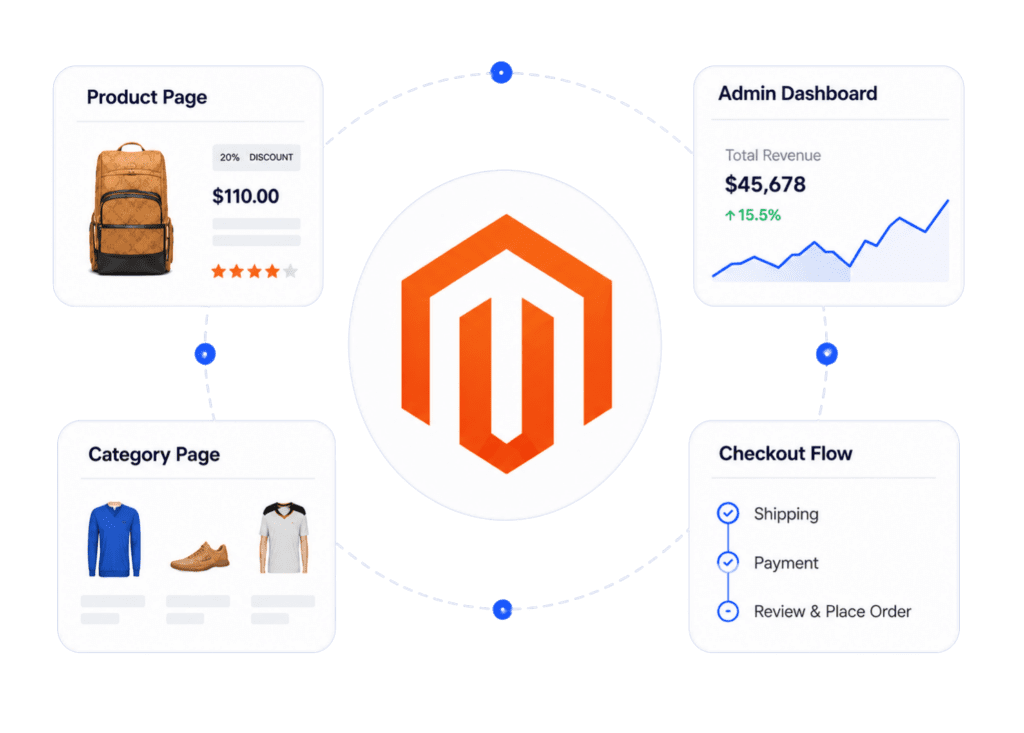
Magento Open Source and Adobe Commerce are designed for businesses that require substantial control over their ecommerce operations. They are particularly relevant when standard platform functionality does not fully accommodate a company’s catalogue, pricing rules, integrations or sales processes.
Magento can support sophisticated product structures, configurable products, customer groups and custom business logic. Adobe Commerce builds on this foundation with additional commercial capabilities, depending on the edition and services selected.
These options are often considered by established retailers, B2B suppliers and businesses with complex operational requirements. A store may need customer-specific pricing, account-based purchasing, integration with an ERP system or different workflows for trade and retail customers. Such requirements can make platform flexibility especially valuable.
Advantages of Magento
Magento offers extensive customisation opportunities and control over the storefront and underlying commerce logic. Developers can build functionality around specific business processes rather than relying entirely on pre-built applications.
Its product and catalogue capabilities can also support businesses with large inventories or complex product relationships. With the right architecture and implementation, Magento can accommodate evolving requirements across marketing, merchandising, customer accounts and integrations.
Limitations of Magento
This flexibility comes with greater implementation and maintenance demands. Development, hosting, security, upgrades and performance optimisation require appropriate technical expertise.
Magento is therefore not automatically the best choice for every retailer. A small business with straightforward requirements may find a hosted platform more economical and easier to manage. The strongest case for Magento emerges when its customisation and operational capabilities provide meaningful business value.
For companies considering this route, a specialist Magento development team can help assess the platform’s suitability, plan integrations and build functionality around specific commercial requirements.
Best for: Established retailers, B2B businesses and growing ecommerce operations with complex requirements.
4. BigCommerce
BigCommerce is a hosted ecommerce platform aimed at businesses that need a broad set of commerce capabilities without managing the entire server infrastructure themselves.
It includes tools for catalogue management, promotions, payments and selling across multiple channels. Its API capabilities also support headless commerce architectures, where the storefront and commerce backend are separated to provide greater flexibility over the customer experience.
BigCommerce can be attractive to growing businesses that need more than a basic online shop but prefer a managed platform.
Advantages and Limitations
A broad set of built-in features can reduce reliance on third-party applications for some common requirements. The hosted model also removes much of the responsibility associated with maintaining the underlying infrastructure.
However, businesses should evaluate its pricing tiers, integration ecosystem, theme options and customisation requirements before committing. The suitability of BigCommerce depends on how well its native functionality aligns with the intended operating model.
Best for: Growing retailers seeking hosted commerce with a broad feature set and integration flexibility.
5. Wix Ecommerce
Wix combines a visual website builder with ecommerce functionality, making it an accessible option for small businesses that want to manage their website and online shop through one system.
Its visual editing tools support the creation of branded storefronts without requiring extensive development. Product management, payment options, shipping settings and promotional features provide the core functionality needed by many smaller retailers.
For a business selling a relatively focused range of products, this approach can reduce the complexity of launching an online store.
Advantages and Limitations
Wix is particularly appealing when website design and ease of use are major priorities. Businesses can create and update pages through a visual interface, while much of the platform infrastructure is managed for them.
The main consideration is long-term complexity. Businesses with extensive product catalogues, sophisticated integrations or highly customised commerce workflows may encounter limitations compared with more specialised ecommerce platforms.
Best for: Small retailers, independent brands and service-led businesses with relatively straightforward selling requirements.
6. Squarespace

Squarespace is another hosted website platform with ecommerce capabilities. It is known for design-focused templates and a streamlined editing experience, making it suitable for businesses that place a strong emphasis on visual identity.
Creative businesses, lifestyle brands and smaller retailers can use it to combine editorial content, brand storytelling and product sales within one website.
Advantages and Limitations
Squarespace provides a convenient way to maintain a consistent visual experience without building a storefront from the ground up. Its managed infrastructure also reduces the need for routine server administration.
Its limitations become more relevant when a business needs extensive catalogue complexity, advanced operational workflows or highly specialised integrations. These requirements should be assessed before choosing Squarespace as the foundation for a long-term commerce operation.
Best for: Design-led businesses and smaller brands with straightforward ecommerce requirements.
Which Ecommerce Platform Is Best for Your Business?
The most appropriate platform depends on the relationship between the business’s current requirements and its future plans. Features alone do not determine suitability; the platform must also fit the team’s technical capabilities, operating costs and growth strategy.
Best Platform for Start-ups
Shopify, Wix and Squarespace can be suitable for businesses launching their first online store. Their managed environments and visual tools reduce the amount of infrastructure and development work required at the beginning.
WooCommerce is another option for businesses that already operate a WordPress website or want greater control over their content and hosting. The right choice depends on how much flexibility is needed and how much technical management the business can support.
Best Platform for Growing Retailers
Growing retailers should pay particular attention to integrations, inventory management, reporting, marketing tools and the cost of additional functionality.
Shopify and BigCommerce may suit businesses that want hosted infrastructure, while WooCommerce can work well where WordPress and content management are central to the wider digital strategy. Magento becomes more relevant when custom workflows, complex catalogues or deeper system integrations become important.
Best Platform for B2B Ecommerce
B2B ecommerce often involves requirements that differ significantly from standard consumer retail. Trade customers may need account-specific pricing, negotiated terms, bulk ordering, purchase orders, approval workflows or integration with existing business systems.
Magento and Adobe Commerce are worth evaluating for these scenarios because of their customisation capabilities and support for complex commerce requirements. However, the final choice should depend on the specific workflows, integration needs and available implementation budget rather than platform reputation alone.
Ecommerce Platform Costs in the UK
Platform costs extend beyond the advertised subscription or licence price. A realistic budget should include implementation, design, hosting where applicable, payment processing, extensions, maintenance and ongoing development.
| Cost area | What to consider |
| Platform fees | Monthly subscriptions, licence charges or edition-specific costs |
| Design and development | Theme configuration, custom design and bespoke features |
| Hosting | Server resources, managed hosting and infrastructure services where required |
| Apps and extensions | Recurring fees for additional functionality |
| Payment processing | Provider fees, transaction charges and any applicable additional costs |
| Maintenance | Updates, backups, security monitoring and technical support |
| Growth | Performance improvements, integrations and new functionality |
Hosted platforms often have more predictable base fees, although app subscriptions and transaction-related costs can increase as a store grows. WooCommerce and Magento offer greater infrastructure control, but hosting, development and maintenance can vary considerably depending on the implementation.
The most useful comparison is therefore the total cost of ownership over several years, not simply the cost of launching the store. A lower initial investment may not remain the most economical option if the business quickly outgrows the platform.
SEO and Performance Considerations
Search visibility should be considered when choosing an ecommerce platform because product discovery depends on more than attractive design. A store needs crawlable pages, useful product information, clear navigation and a technical structure that allows search engines to understand its content.
Platforms differ in how they handle URLs, metadata, canonical tags, redirects, structured data and other SEO elements. Some controls are available natively, while others depend on themes, extensions or custom development.
Technical SEO and Site Speed
Page speed and mobile usability can influence the quality of the shopping experience. Large images, excessive scripts, poorly configured extensions and inefficient backend processes can affect performance regardless of the platform selected.
A strong implementation should include appropriate image optimisation, efficient code, caching where supported and regular performance monitoring. Core Web Vitals should also be reviewed as part of the wider technical SEO process.
Product and Category Optimisation
Product pages need accurate titles, useful descriptions, relevant specifications and consistent product information. Category pages should help customers understand the available range while providing clear navigation through the catalogue.
Structured data can help search engines interpret product information, including price, availability and review details when the relevant properties are implemented correctly. These features depend on the accuracy of the underlying data as well as the platform’s technical configuration.
UK-Specific Ecommerce Requirements
A suitable platform must support the practical requirements of operating an online business in the UK. Payment preferences, delivery arrangements, tax configuration and customer data handling should all be considered during implementation.
Payments and Delivery
Businesses should confirm that their chosen platform supports the payment providers and methods they intend to offer. Depending on the business model, this may include card payments, digital wallets, buy-now-pay-later services or alternative payment options.
Shipping integrations are equally important for businesses managing multiple couriers, delivery rates, tracking information or international orders. Compatibility should be verified before launch, particularly when fulfilment processes rely on external systems.
VAT and Data Protection
The platform should support the business’s tax configuration and provide the information required for accurate order processing and reporting. VAT treatment depends on the business, products and transactions involved, so platform settings should be configured with appropriate accounting guidance.
UK businesses must also consider applicable data protection and privacy obligations. Cookie consent, customer information, marketing permissions and third-party integrations should be reviewed as part of the implementation rather than left until after launch.
How to Choose the Right Platform
A platform decision should begin with business requirements, not a feature comparison alone. Product complexity, sales channels, customer types, integrations and internal resources all influence the most appropriate solution.
It is also important to consider the team’s ability to manage the chosen platform. A flexible system can deliver significant value, but only when the business has access to the expertise required to maintain and develop it.
Before making a final decision, businesses should establish their essential requirements, estimate total ownership costs and identify any functionality that would require custom development. Reviewing the platform’s upgrade path and migration options can also help avoid unnecessary constraints later.
Final Thoughts
The best ecommerce platform in the UK is the one that aligns with a business’s operating model, budget and long-term objectives. Shopify and BigCommerce offer managed commerce environments, WooCommerce provides flexibility within WordPress, and Magento or Adobe Commerce can support more complex retail and B2B requirements. Wix and Squarespace remain practical choices for businesses with simpler selling needs and design-led priorities.
Choosing well requires looking beyond the initial launch. The right platform should support effective product management, a strong customer experience, reliable performance and the integrations needed to operate efficiently as the business grows.
For businesses evaluating a new store or planning a more complex ecommerce build, a clear understanding of technical and commercial requirements is the best starting point for making a sustainable platform decision.


 Tom
Tom