





















What Is Headless Magento Development?
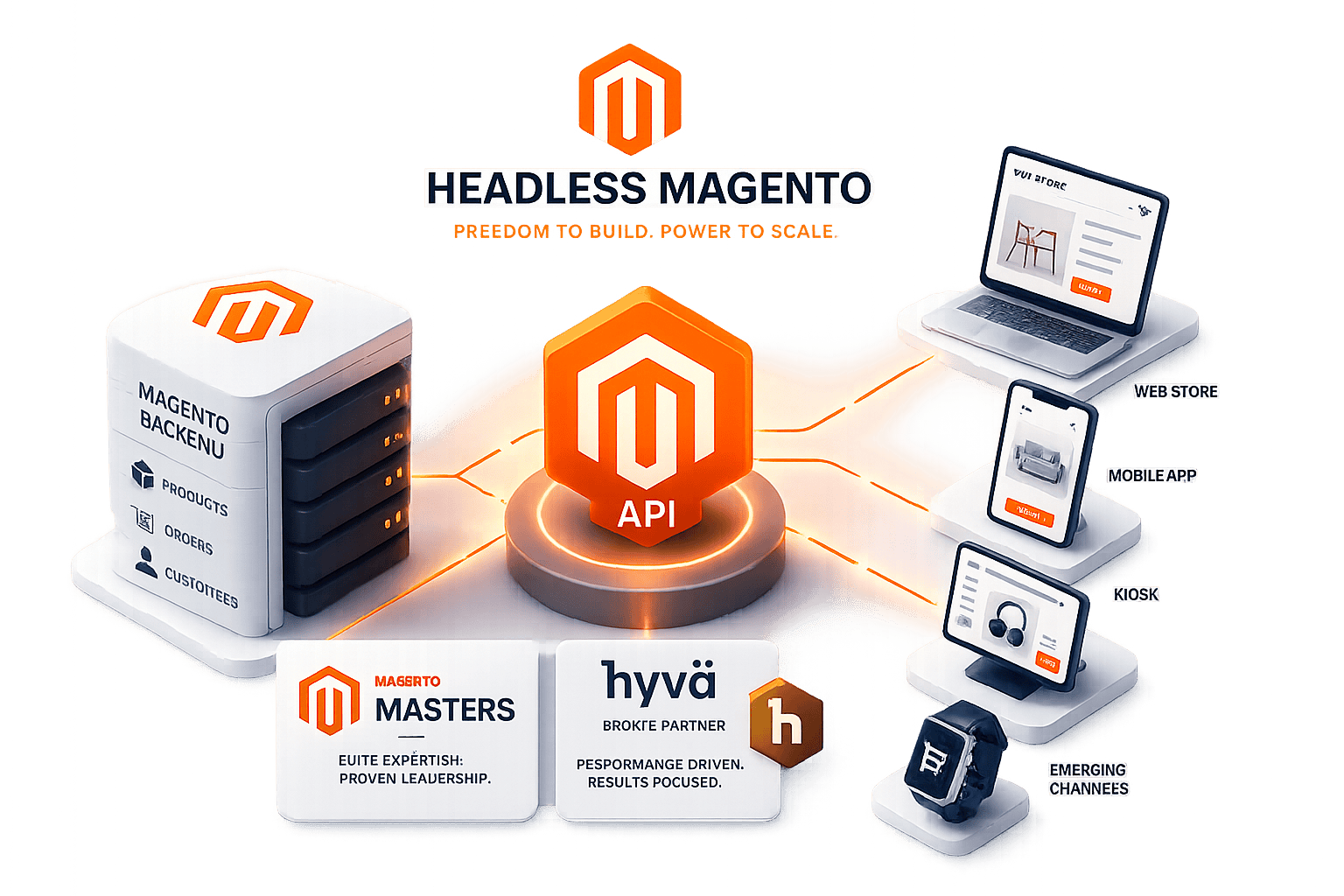
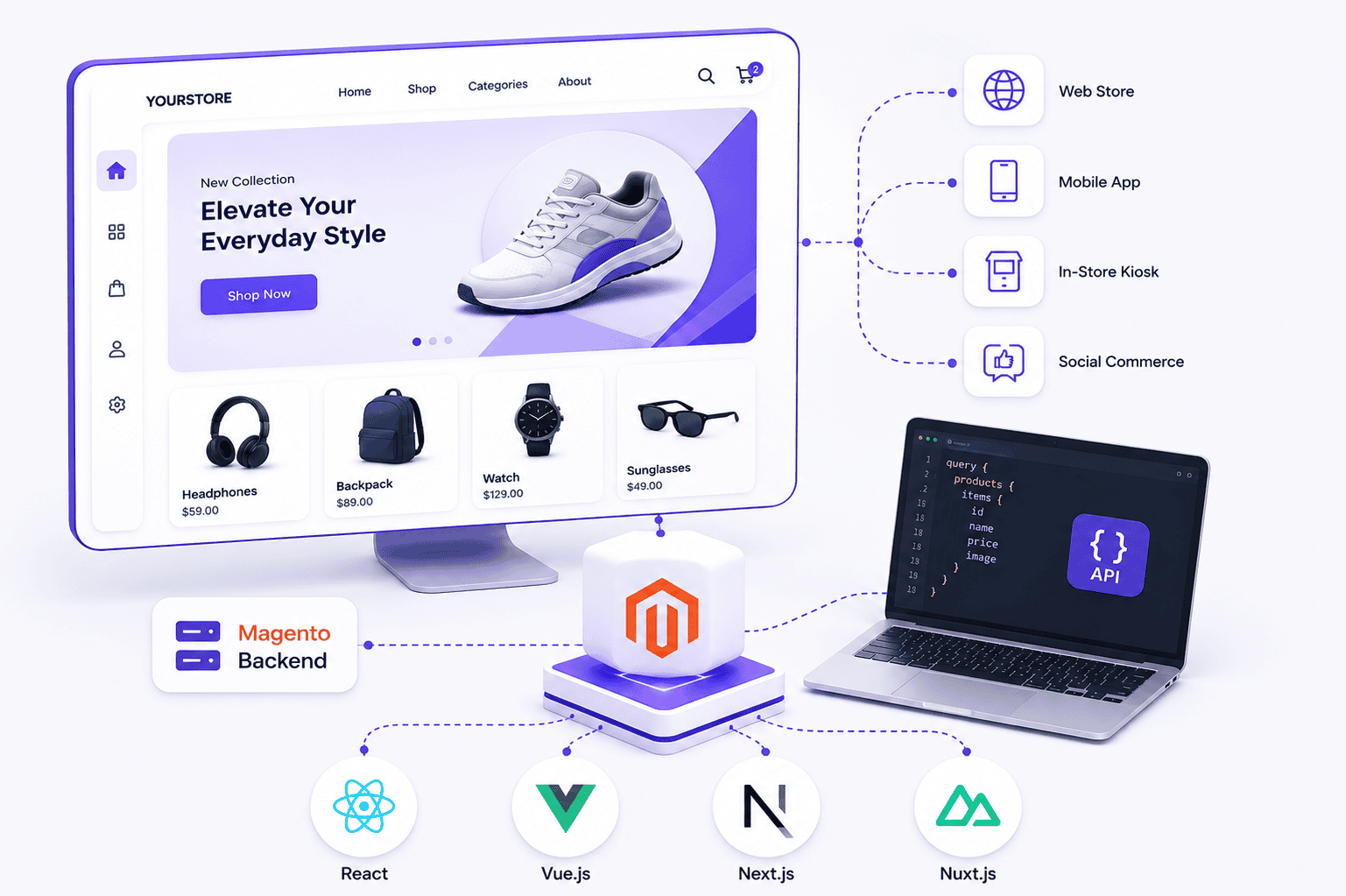
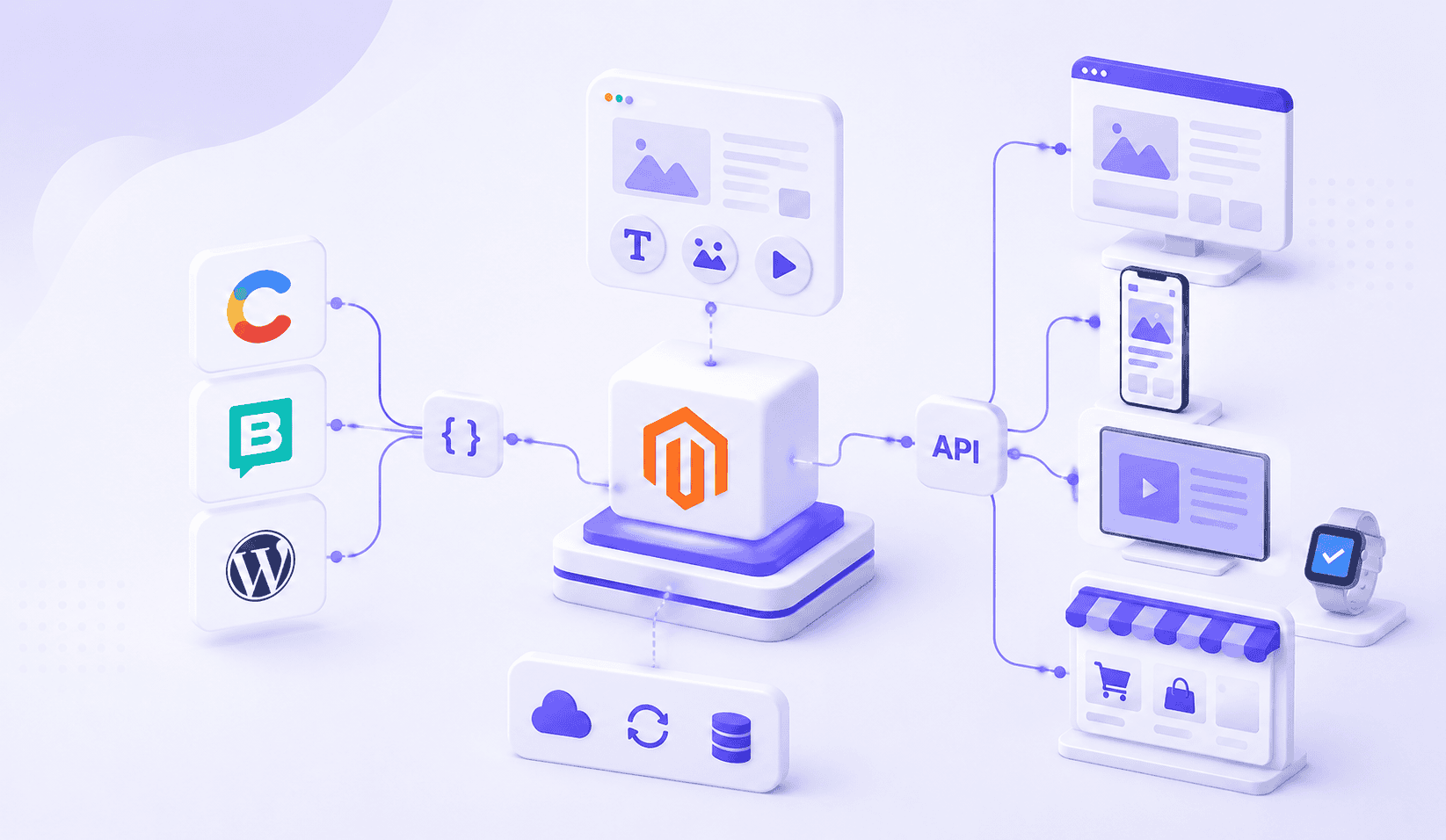
Headless Magento development is an ecommerce architecture that separates the Magento backend from the frontend storefront. Magento manages products, customers, orders, inventory and commerce operations, while an independent frontend built with technologies such as React, Next.js, Vue.js or Nuxt.js communicates through GraphQL and REST APIs. Headless Magento development services include custom storefront development, API integration, PWA implementation, headless CMS integration, migration, SEO optimisation and ongoing support. This approach gives businesses greater frontend flexibility and supports multiple digital touchpoints, but requires careful architecture, testing and maintenance.
Your Magento backend should support your business, not restrict the experiences you can build around it. When a conventional Magento storefront limits your frontend flexibility, performance strategy or ability to deliver across multiple customer touchpoints, headless architecture can provide a different approach.
KiwiCommerce delivers headless Magento development services for businesses that need greater control over their ecommerce frontend while retaining Magento’s powerful backend capabilities. We separate the presentation layer from the commerce platform, allowing your developers to build custom storefront experiences that communicate with Magento through APIs.
Whether you need a new Magento 2 headless storefront, a Progressive Web App (PWA), a headless CMS integration or a complete frontend transformation, our team can help plan and implement an architecture around your business requirements.
As a Magento and Adobe Commerce development agency, we approach headless ecommerce as an architectural decision rather than simply a frontend replacement. The objective is to create a system that performs well, integrates reliably and remains maintainable as your ecommerce operations grow.
What Is Headless Magento Development?
Headless Magento development is the process of separating the Magento ecommerce backend from the frontend storefront. Instead of relying on Magento’s traditional presentation layer, developers build an independent frontend application that communicates with the Magento backend through APIs.
Magento continues to manage the core commerce functionality, including:
- Product catalogues, categories and product information.
- Customer accounts and authentication.
- Shopping carts, checkout and orders.
- Inventory, pricing and promotions.
- Payment and shipping integrations.
- Store configuration and ecommerce business logic.
The independent frontend controls how customers interact with this information. It can be developed using modern technologies such as React, Vue.js, Next.js or Nuxt.js, depending on the project’s requirements.
Magento GraphQL and REST APIs allow the frontend to request and exchange the data it needs without depending on Magento’s traditional theme rendering.
This separation gives businesses more control over storefront design, frontend technology and deployment cycles. It also creates opportunities to use the same commerce backend across different customer-facing channels.
For a deeper technical explanation, read our guide to Magento headless commerce architecture.
Headless vs Monolithic Magento Architecture
Traditional Magento uses a more closely connected frontend and backend architecture. The Magento application manages commerce functionality while its theme and presentation components generate the storefront experience.
Headless Magento separates these responsibilities. The backend continues to manage ecommerce operations, while an independently developed frontend communicates with it through APIs.
Traditional Magento: Monolithic Architecture
In a traditional Magento implementation, the storefront relies on Magento’s built-in theme and rendering structure. Developers work within Magento’s frontend architecture when modifying layouts, templates and customer-facing functionality.
This approach can be effective for businesses with standard storefront requirements. It also provides a more integrated development and maintenance model.
However, businesses with highly customised customer experiences, multiple frontend applications or specific technology requirements may find the conventional frontend restrictive.
Headless Magento: Decoupled Architecture
With headless Magento, the frontend and backend operate as separate applications. The frontend requests commerce data through APIs, processes the response and displays the customer experience independently.
This allows frontend developers to work with modern JavaScript frameworks without replacing Magento’s underlying commerce capabilities.
The main architectural difference is that frontend development and backend commerce development can progress more independently. However, this flexibility introduces additional responsibility for API integration, deployment, testing and ongoing maintenance.
Headless is not automatically the better option for every Magento store. The architecture should solve a genuine business or technical problem that justifies the additional complexity.
Why Choose Headless Magento for Ecommerce Website Development?
Headless Magento development can be valuable when your existing storefront architecture is limiting the way your business wants to operate, expand or serve customers.
Greater Frontend Flexibility and Design Freedom
A headless Magento storefront gives developers greater control over the presentation layer. They can build custom interfaces, interactive product experiences, tailored navigation and checkout journeys without relying on Magento’s conventional theme structure.
This is particularly useful for brands with distinctive customer experiences or complex frontend requirements that are difficult to implement within a traditional theme.
Performance-Focused Storefront Development
An independent frontend gives developers greater control over how pages are rendered, how assets are delivered and how customer interactions are handled.
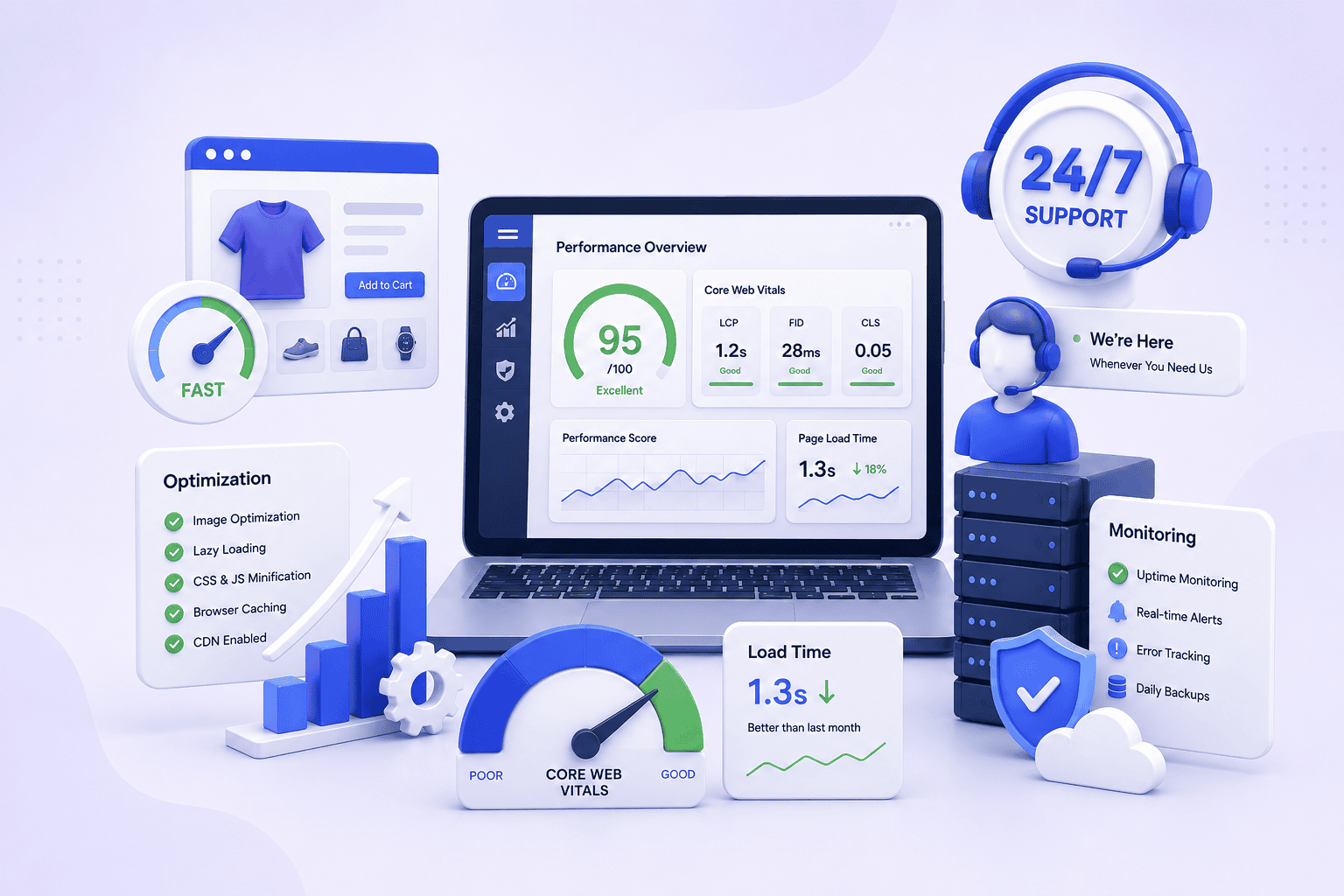
Using suitable rendering strategies, caching, code splitting, image optimisation and efficient API requests can improve storefront responsiveness and loading performance.
However, headless architecture does not guarantee a faster website. Poorly optimised JavaScript, excessive API requests, slow backend responses or an inefficient rendering strategy can create new performance problems.
Our focus is to design the frontend and API architecture around measurable performance requirements rather than assuming that decoupling alone will improve speed.
Omnichannel Ecommerce Experiences
A single Magento backend can provide commerce data and functionality to multiple independently developed customer-facing applications.
Depending on the architecture, these may include:
- Ecommerce websites and mobile storefronts.
- Progressive Web Applications.
- Customer portals and B2B ordering interfaces.
- In-store kiosks and digital displays.
- Additional digital commerce touchpoints.
This approach can help businesses maintain centralised product, inventory and order management while delivering different frontend experiences for different audiences.
Independent Frontend and Backend Development
Headless architecture allows frontend and backend teams to work on separate development cycles, provided that API contracts and integration requirements are properly managed.
Frontend teams can develop customer-facing features while Magento developers maintain commerce logic, integrations and backend functionality.
This separation can support faster iteration, but it requires clear technical documentation, version management and coordination between development teams.
Greater Technology and CMS Flexibility
A headless Magento frontend is not restricted to Magento’s traditional presentation layer. Businesses can select frontend frameworks and integrate a separate content management system where appropriate.
For example, a marketing team could manage editorial content through a headless CMS while Magento remains responsible for products, customers, carts and orders.
This gives ecommerce businesses greater flexibility over how content and commerce experiences are created and delivered.
What Are Headless Magento Development Services?
Headless Magento development involves more than building a separate storefront. A successful implementation requires frontend development, backend integration, API architecture, content management, testing and ongoing technical support.
KiwiCommerce provides headless Magento development services covering the different components of a decoupled ecommerce platform.
Custom Headless Magento Storefront Development
We build custom Magento storefronts using modern frontend technologies selected according to your requirements.
Depending on the project, the frontend may use React, Next.js, Vue.js or Nuxt.js. The objective is to create a storefront that supports your design requirements, customer journeys and business functionality while communicating reliably with Magento.
Magento 2 Headless Development and API Integration
API integration is central to Magento 2 headless development. The frontend needs to retrieve and update commerce information without depending on Magento’s traditional page rendering.
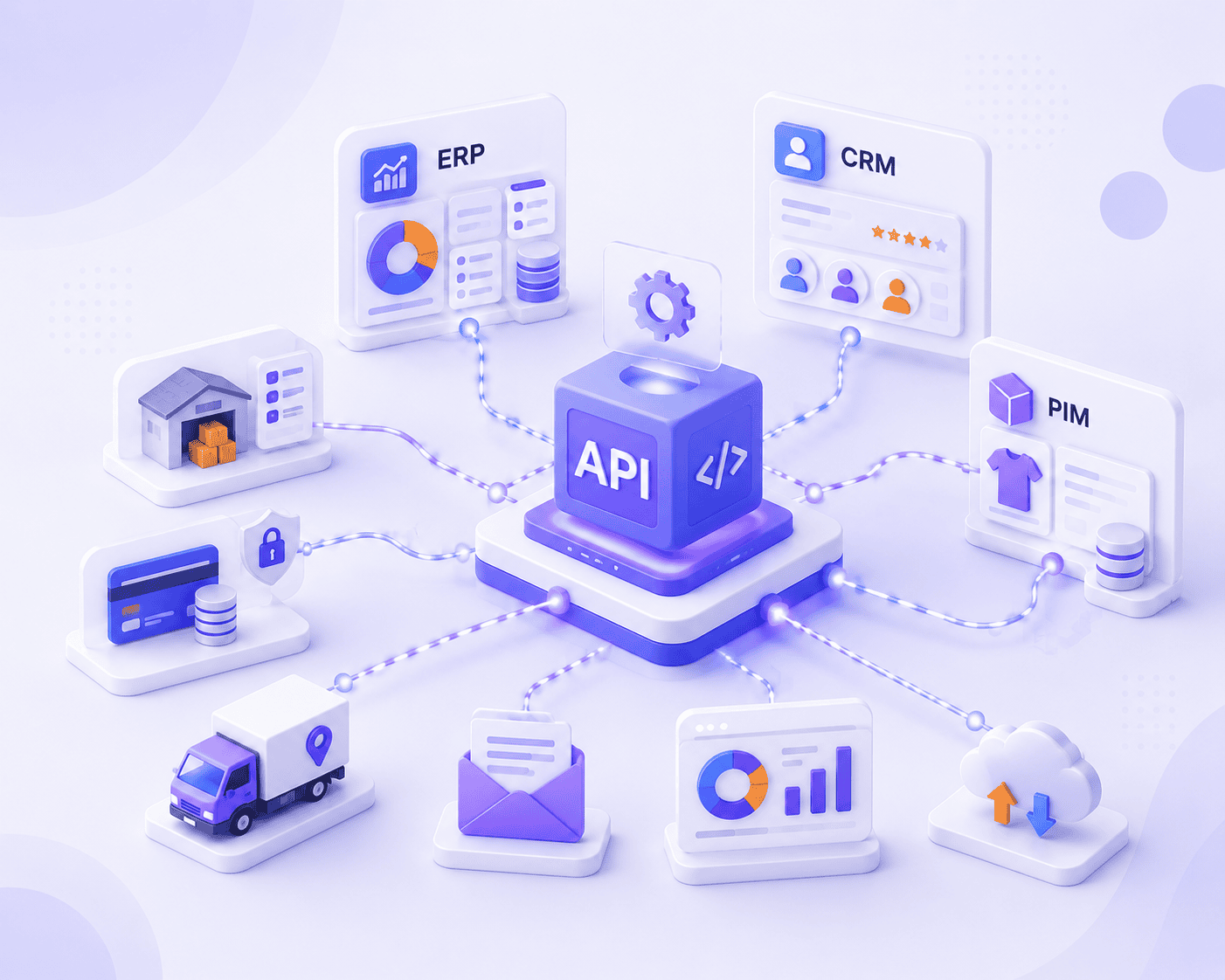
We work with Magento GraphQL and REST APIs to connect frontend applications with backend functionality, including product catalogues, customer accounts, cart operations and checkout workflows.
Where standard API capabilities do not cover specific business requirements, custom development may be needed to extend the integration.
For wider integration requirements, explore our custom third-party API integration services.
Headless CMS Integration
A headless CMS separates content management from content presentation. This allows editorial teams to manage content independently while the frontend retrieves and displays it through APIs.
We can plan headless CMS integrations involving platforms such as Contentful, Storyblok or WordPress, depending on your content workflows and technical requirements.
This can be useful for businesses managing multiple storefronts, regional websites, landing pages and content-led shopping experiences.
Magento PWA Development
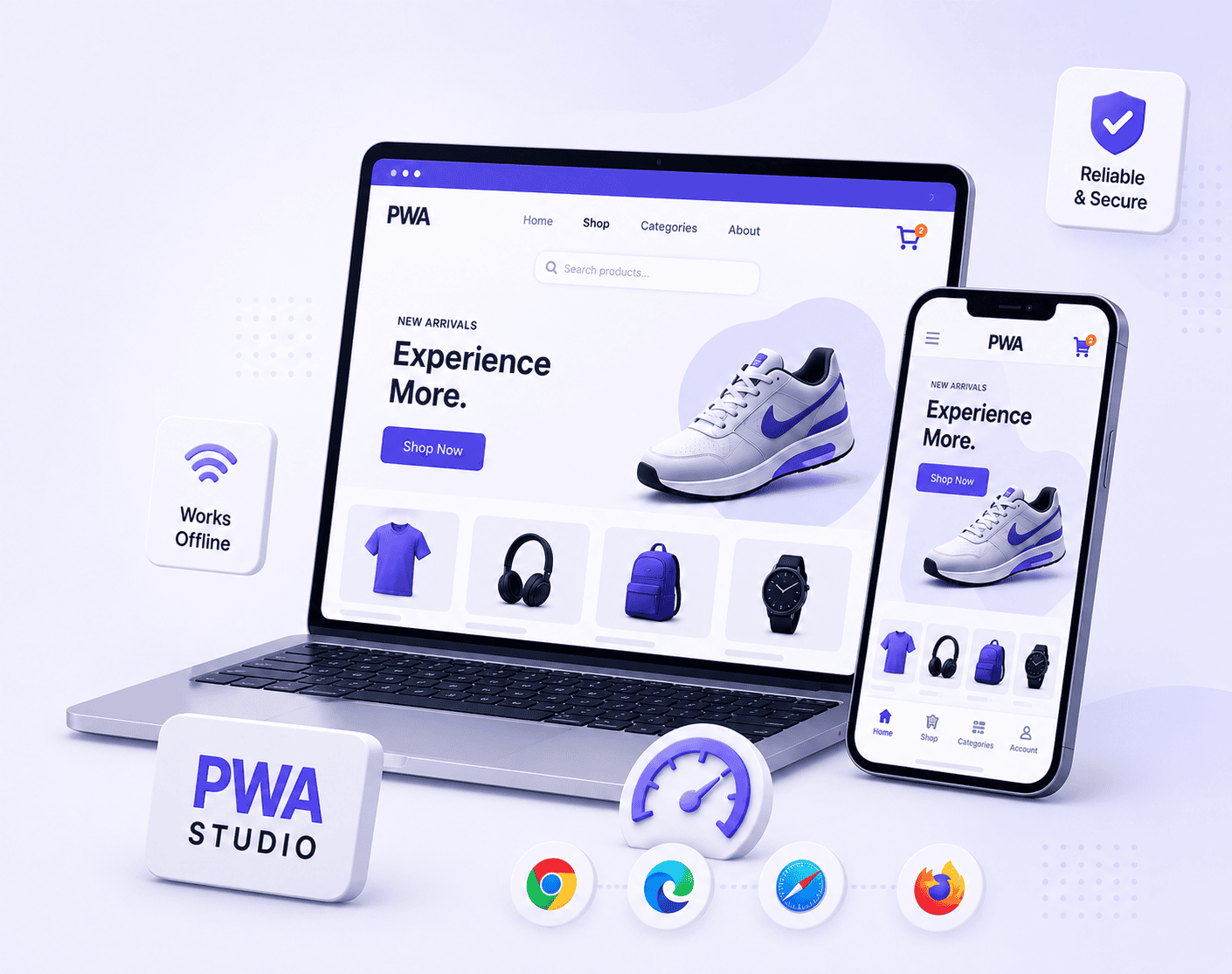
Progressive Web Apps can provide app-like storefront experiences through a web browser. They can support responsive interfaces, installable experiences and selected offline capabilities, depending on implementation.
Adobe Commerce PWA Studio provides tools for developing PWA storefronts for Adobe Commerce and Magento Open Source. Custom frontend approaches can also be used.
PWA and headless are closely related but are not interchangeable terms. A PWA can use a headless Magento backend, but not every headless storefront needs to be a PWA.
Explore our dedicated Magento 2 PWA development services if you are considering an app-like ecommerce experience.
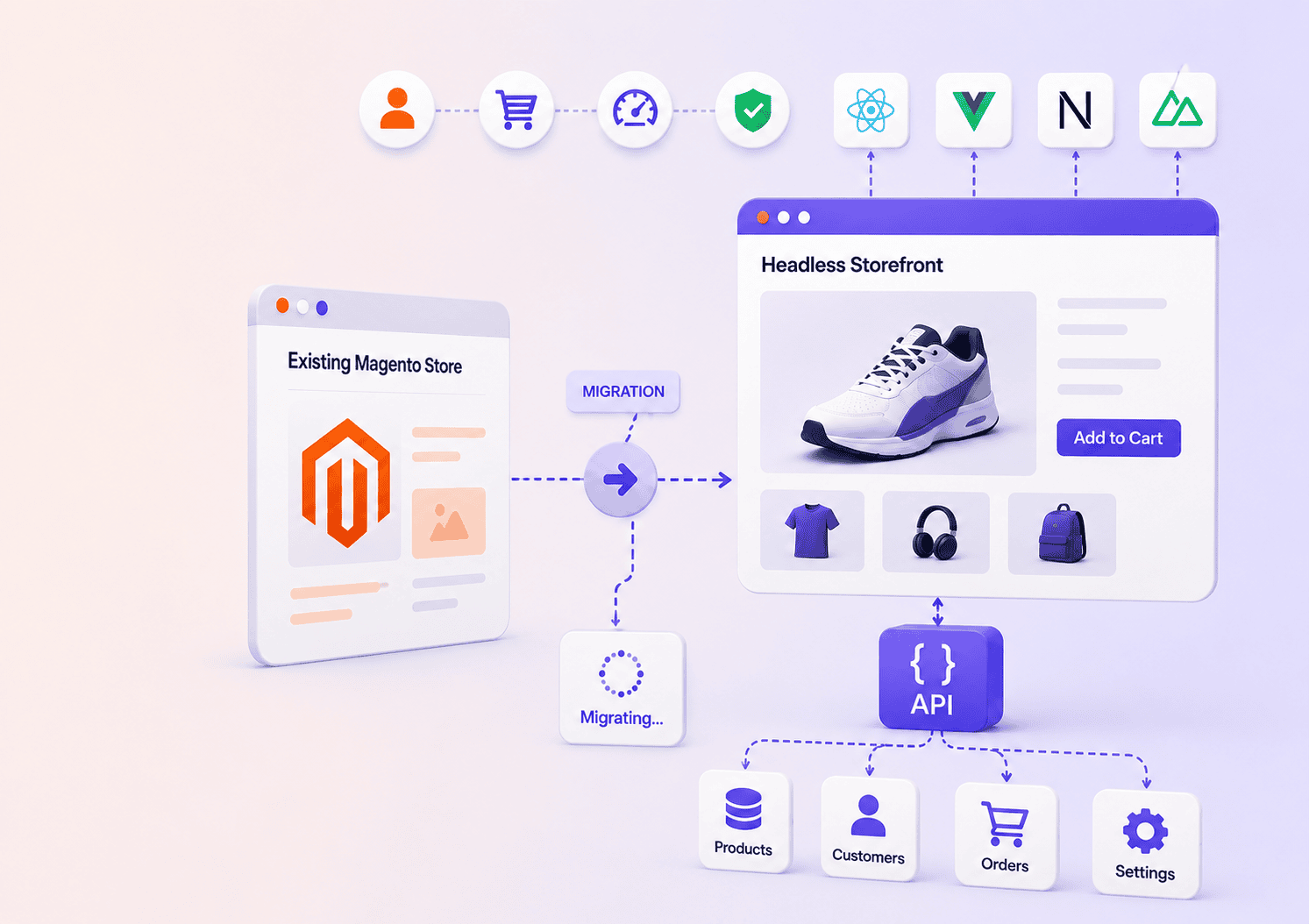
Headless Migration and Replatforming
Businesses with an existing Magento store may want to move from a traditional frontend to a decoupled architecture without rebuilding their entire commerce backend.
A headless migration can involve frontend redevelopment, API implementation, integration changes, content restructuring and updates to deployment infrastructure.
The migration strategy should account for existing store functionality, customer journeys, third-party extensions, SEO requirements and business continuity.
Our ecommerce replatforming and migration services can help plan the wider transition.
Headless Performance Optimisation and Technical Support
A headless storefront requires ongoing attention to both frontend and backend performance. Developers need to monitor rendering, API response times, caching, application errors and integration reliability.
We can support ongoing technical improvements, compatibility checks, frontend optimisation and maintenance as your Magento platform evolves.
For wider Magento maintenance requirements, explore our Magento technical support and maintenance services.
How Magento Headless Development Works: Our Process
A successful headless Magento project starts with architecture and business requirements, not with selecting a JavaScript framework. The decisions made during discovery affect development scope, integration complexity, performance and long-term maintenance.
Our headless Magento development process follows a structured approach.
1. Discovery and Technical Assessment
We understand your business model, existing Magento implementation, customer journeys and reasons for considering headless architecture.
This includes reviewing the current theme, extensions, integrations, performance challenges, content requirements and future channels. We also assess whether a fully headless or hybrid approach is appropriate.
2. Headless Architecture and Technology Planning
We define how the frontend, Magento backend, APIs, CMS and third-party systems will work together.
This stage covers frontend framework selection, API requirements, authentication, hosting, caching, deployment strategy and integration responsibilities.
The architecture should account for future development as well as the initial launch.
3. Frontend UX and Storefront Development
Our developers build the independent storefront around your design, usability and conversion requirements.
This includes responsive layouts, product discovery, navigation, product detail pages, customer interfaces and other essential ecommerce journeys.
4. Magento Backend and API Integration
We connect the new frontend with Magento using GraphQL and REST APIs where appropriate.
The integration covers the required commerce operations, including catalogue data, customer information, cart functionality, checkout and order-related workflows. Custom API development may be required for business-specific functionality.
5. CMS and Third-Party System Integration
Where required, we connect the storefront with a headless CMS, ERP, CRM, PIM, payment provider, shipping platform or other external system.
The objective is to ensure that data moves consistently between the storefront, Magento and the wider business technology ecosystem.
6. Testing, SEO and Performance Optimisation
Before launch, we test the complete customer journey across devices and browsers.
Testing covers API responses, frontend functionality, product and category navigation, customer accounts, cart and checkout, integrations, security and performance. We also validate SEO elements such as metadata, rendering, canonical tags, structured data and redirects.
7. Launch and Ongoing Development Support
After testing and release preparation, we deploy the headless storefront and monitor the implementation.
Post-launch support can include bug fixes, performance improvements, Magento compatibility work, API changes and new frontend features.
Migrating to Headless Magento Without Breaking SEO
One of the biggest concerns when moving to headless Magento is protecting existing organic search performance. Replacing the frontend can change how search engines access, render and understand website content.
A headless Magento migration must therefore include SEO requirements from the beginning, rather than treating SEO as a final pre-launch check.
Maintain Existing URLs and Implement Redirects
Preserve existing product, category and content URLs wherever possible. If the new storefront requires URL changes, create a complete redirect mapping and implement relevant permanent redirects.
Avoid unnecessary URL changes because they introduce additional migration risk.
Implement Server-Side Rendering or Static Rendering Where Appropriate
Search engines need to access meaningful page content. Depending on the frontend framework and rendering strategy, server-side rendering (SSR), static site generation (SSG) or other suitable approaches may be used.
Do not rely on client-side JavaScript rendering without testing how important pages are delivered and indexed.
Preserve Metadata and Canonical Tags
Product pages, category pages and editorial content should retain appropriate title tags, meta descriptions, canonical URLs and other relevant metadata.
The new frontend must also handle pagination, filters, sorting and duplicate URL variations correctly.
Maintain Structured Data and Product Information
Product structured data should continue to reflect accurate product information, including pricing, availability and other applicable attributes.
Review breadcrumb, organisation and other relevant structured data during the transition.
Update XML Sitemaps and Robots Directives
Ensure the new storefront generates or exposes valid XML sitemaps containing indexable canonical URLs. Review robots directives so that important content is crawlable and staging environments are not unintentionally indexed.
Monitor Search Performance After Launch
After deployment, monitor Google Search Console for indexing issues, crawl errors, redirect problems and changes in organic search performance.
A well-planned headless migration should include technical SEO testing before launch and continued monitoring afterwards. For additional guidance, explore our Magento SEO services.
Headless Magento vs Hyvä: Which Frontend Is Right for Your Store?
Headless Magento and Hyvä address different frontend requirements. Choosing between them depends on the level of flexibility your business needs, the existing Magento implementation and the resources available for ongoing development.
Headless architecture separates the frontend application from the Magento backend. It is useful when you need independent frontend applications, multiple customer-facing channels or a highly customised technology stack.
Hyvä is a modern Magento theme approach that replaces the traditional Luma frontend while retaining Magento’s integrated storefront architecture. It can provide a lighter frontend and significant performance improvements without requiring a fully decoupled application.
Consider headless Magento when:
- You need multiple independent storefronts or digital touchpoints.
- Your business requires a highly customised frontend architecture.
- You need a dedicated frontend technology stack.
- You have the technical resources to manage separate applications and API integrations.
Consider Hyvä when:
- You want a modern, faster Magento storefront.
- Your requirements can be delivered within Magento’s integrated architecture.
- You want to reduce the additional complexity of a separate frontend application.
- Extension compatibility and a more straightforward maintenance model are important.
Explore our Hyvä theme development services to understand the alternative. You can also read our comparison of Hyvä Theme vs PWA for Magento.
The right solution is the one that addresses your actual business requirements without introducing unnecessary architectural complexity.
How to Choose the Right Headless Magento Development Company
Choosing a headless Magento development company requires evaluating more than its ability to build a modern frontend. The agency must understand Magento’s backend architecture, API capabilities, ecommerce workflows and the operational demands of maintaining separate applications.
Before selecting a headless Magento development agency, consider the following:
Magento and Adobe Commerce Expertise
Your development partner should understand Magento 2 architecture, backend functionality, extensions, GraphQL and REST APIs. General React or Vue.js experience alone is not enough for a complex headless Magento project.
Proven Frontend Framework Experience
Ask about the frontend technologies the team has implemented and how they select frameworks for different requirements. The choice between React, Next.js, Vue.js and Nuxt.js should be based on architecture, rendering, performance and maintainability.
API Architecture and Integration Knowledge
The agency should understand API design, authentication, data exchange, error handling and custom GraphQL development. It should also be able to explain how the frontend will interact with Magento and external business systems.
Technical SEO and Performance Experience
A headless Magento development company should understand server-side rendering, page indexing, metadata, structured data, canonical URLs and redirect management.
Performance should be assessed through real implementation and testing rather than promises that headless architecture will automatically make a store faster.
Long-Term Maintenance and Support
Headless stores have separate frontend and backend applications, which creates additional maintenance responsibilities. Ask how the agency handles Magento upgrades, frontend framework updates, API changes, security patches and ongoing optimisation.
Clear Architecture, Documentation and Ownership
Your development partner should document the architecture, APIs, integrations, deployment process and key technical decisions. This helps your internal team understand the system and reduces unnecessary dependency on a single developer or agency.
Certified Magento Developers for Headless Ecommerce Projects
Headless Magento projects require developers who can work across Magento backend development and independent frontend technologies. The team needs to understand how ecommerce functionality, API communication and customer-facing applications fit together.
KiwiCommerce brings Magento and Adobe Commerce development experience to headless ecommerce projects, supported by frontend, backend and integration capabilities.
Our credentials include Adobe Commerce Gold Solution Partner status and official Hyvä Bronze Partner status. Our founder is also a Magento Master, reflecting longstanding involvement in the Magento ecosystem.
These platform credentials are not a separate certification for headless development. The relevant expertise comes from combining Magento knowledge with the technical skills required to plan, build and maintain decoupled storefronts.
Why Choose KiwiCommerce for Headless Magento Development?
A headless implementation should solve a genuine architectural challenge, not create complexity for its own sake. KiwiCommerce approaches Magento headless development with a focus on the long-term needs of your ecommerce business.
- Magento-first technical expertise: We understand the Magento and Adobe Commerce backend that powers your ecommerce operations.
- Architecture-led development: We assess requirements before recommending a frontend framework or decoupled architecture.
- Modern frontend capabilities: We work with technologies such as React, Vue.js, Next.js and Nuxt.js according to project needs.
- API and integration experience: We connect Magento with frontend applications, CMS platforms and third-party business systems.
- SEO-conscious implementation: We consider rendering, crawlability, URL structures and metadata throughout the development process.
- Performance-focused engineering: We optimise frontend delivery, API communication and backend interactions rather than relying on architectural assumptions.
- Wider ecommerce development support: Our team can support Magento development, integrations, performance improvements and ongoing maintenance.
We also understand that headless is not always the right answer. If a modern Magento theme can meet your requirements with less complexity, we will help you assess that option before committing to a larger architectural change.
Whether you are planning a new Magento 2 headless storefront, modernising an existing ecommerce website or exploring omnichannel commerce, we can help define a practical development approach.
Build a Headless Magento Storefront That Supports Your Next Stage of Growth
Your ecommerce architecture should give your business room to evolve without creating unnecessary technical overhead. Whether you need a custom headless Magento storefront, Magento 2 API development, PWA implementation or headless CMS integration, KiwiCommerce can help you plan and deliver the right solution.
Let’s discuss your current Magento setup, frontend requirements and long-term ecommerce goals before deciding on the architecture.