

Introduction
If your Magento store is still running on Luma, you already know something needs to change. Pages are slow. Mobile scores are poor. Developers dread working in the codebase. The question is what to replace it with.
Two options come up in almost every conversation: Hyvä and PWA. Both fix the performance problems Luma creates. Both are genuine improvements. But they are built on completely different ideas about what a Magento frontend should be and the choice between them affects your costs, your timeline, your developer team, and how easy your store is to manage for years after launch.
This guide covers both options honestly. It was written by the KiwiCommerce team Adobe Commerce Certified and Hyvä Bronze Partner developers based in Cheshire, UK, with 250+ eCommerce projects delivered since 2016. We have built both, and we will tell you which one is right for most stores and when PWA is genuinely the better call.
What Hyvä Actually Is
Hyvä is a Magento 2 frontend framework. It replaces Luma’s default technology stack KnockoutJS, RequireJS, and jQuery with Tailwind CSS for styling and Alpine.js for interactivity.
The result is pages that are significantly lighter and faster than Luma. A typical Luma product page ships around 900KB of data to a browser. The same page on Hyvä ships around 150KB. That reduction in page weight is what produces Lighthouse scores above 90 scores that most Luma stores cannot reach without a full frontend rebuild.
Hyvä is server-rendered. That means Magento still generates the page on the server and sends complete HTML to the browser, exactly as Luma does. The browser does not need to run a JavaScript application before showing the page. This keeps the architecture simple and keeps compatibility with the Magento extension ecosystem largely intact.
Since November 2025, the core Hyvä theme has been free and open source. The previous per-store licence cost which had been the main barrier to adoption was removed when Hyvä was released under the same open-source licences as Magento itself. The latest version is 1.4.4.
For a deeper look at what Hyvä is and what the full product suite includes, our Hyvä Commerce guide explains both the core theme and the paid Hyvä Commerce platform that launched in July 2025.
What PWA Actually Is
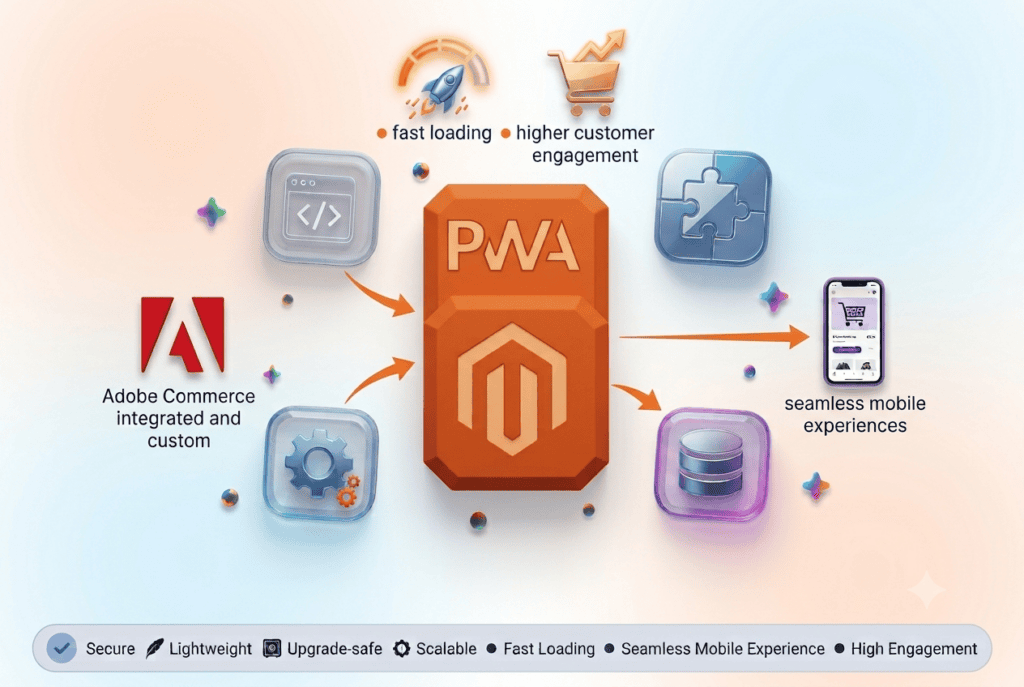
A Magento PWA (Progressive Web App) takes a completely different approach. Instead of server-rendering pages, it builds a separate JavaScript application typically in React that runs in the browser and pulls data from Magento through GraphQL APIs.
The Magento backend stays in place. The entire storefront product pages, search, cart, checkout is rebuilt as a React application that communicates with Magento rather than relying on Magento to generate the page directly.
This architecture is what gives PWA its distinctive capabilities. Because the frontend runs as a JavaScript app, it can cache pages for offline access, send push notifications, and be added to a phone’s home screen like a native app. These are genuine features Hyvä cannot offer because Hyvä’s server-rendered architecture does not support them.
The main tools for Magento PWA are PWA Studio (Adobe’s official React-based toolkit) and Vue Storefront (an independent headless framework). PWA Studio is the most widely used.
The Core Difference in One Paragraph
Hyvä keeps your Magento store as a traditional, server-rendered website just with a modern, fast frontend instead of Luma’s slow one. PWA replaces the entire frontend architecture with a separate JavaScript application. Hyvä is an upgrade to what you have. PWA is a rebuild from a different starting point.
Performance: How Do They Actually Compare?
Both Hyvä and a well-built PWA can achieve high Lighthouse scores and fast page loads. The practical difference is in how predictably each gets there.
Hyvä scores above 90 on Lighthouse mobile consistently for well-implemented stores. The framework is designed specifically for Magento, which means performance is baked into how it works rather than something to engineer separately. Our Hyvä Theme Development service page notes that KiwiCommerce’s Hyvä builds consistently achieve 90+ Lighthouse scores.
PWA performance depends heavily on implementation quality. React applications can be extremely fast but they can also be slow if rendering is not optimised, if too much JavaScript loads upfront, or if server-side rendering (SSR) is not configured properly. A badly implemented PWA can actually score worse on Core Web Vitals than a well-implemented Hyvä store. The performance ceiling for PWA is higher but the floor is lower too.
For most UK Magento merchants, Hyvä delivers better real-world performance outcomes more reliably than a PWA build of equivalent cost and timeline.
Extension Compatibility: The Most Important Practical Difference
This is where the two approaches diverge most sharply for real stores.
Magento stores typically run a mix of third-party extensions. Most of these were built for the Luma frontend. Hyvä keeps the Magento architecture intact, extensions that do not interact with the frontend continue to work with no changes. Extensions that do interact with the frontend need a Hyvä compatibility check, but many now ship Hyvä-compatible versions, and the Hyvä ecosystem includes a compatibility module that covers a large portion of the extension library. Our guide to making Magento 2 extensions compatible with Hyvä covers what this process involves.
With PWA, the situation is more demanding. PWA replaces the Magento frontend with a completely separate React application. Extensions that rely on Luma for their frontend output which is most of them do not work in a PWA without rebuilding their frontend components as React modules and exposing their data through GraphQL. Every extension in your stack needs this assessment before a PWA project begins. Some extensions simply cannot be made PWA-compatible without replacing them entirely.
If you run 20+ extensions which most mid-sized Magento stores do, the extension compatibility work alone can double the scope of a PWA project.
Development Cost and Timeline
This is where the difference between Hyvä and PWA is most striking.
| Hyvä | PWA Studio | |
| Typical timeline | 4–8 weeks (standard store) | 16–40 weeks |
| Estimated cost (UK agency) | From £8,000–£20,000 | From £40,000–£120,000+ |
| Developer skills needed | Magento + Tailwind CSS + Alpine.js | Magento + React + GraphQL + Apollo Client + service workers |
| Extension compatibility work | Most extensions need minor changes or have compatibility modules | Each extension needs GraphQL API work or full rebuild |
| Ongoing maintenance | Standard Magento skillset | React expertise required long-term |
The cost gap reflects something real. PWA requires five overlapping technical specialisms: Magento development, React, GraphQL schema design, Apollo Client, and service-worker debugging. That combination is difficult to hire for and commands premium rates. Three years after launch, when the original team has moved on and you need someone to maintain or extend your PWA storefront, finding qualified developers at a sensible cost is genuinely hard.
Hyvä maintenance requires a Magento developer who knows Tailwind CSS. That is a much more accessible hiring brief.
SEO: Does Architecture Matter?
Hyvä has no SEO disadvantage over Luma. It is server-rendered, which means Google receives fully-formed HTML pages. All existing Magento SEO configurations include canonical tags, metadata, structured data work as they did on Luma.
PWA has a known SEO complexity. Because the frontend is a JavaScript application, the page is not always fully rendered before Googlebot indexes it. Without server-side rendering (SSR) configured correctly, Google may index an empty shell rather than the page content which damages rankings significantly. Most professional PWA Studio implementations include SSR, but it adds to build complexity and requires active maintenance as the application evolves.
Hyvä’s clean, crawlable HTML structure is one of the reasons it has become the default choice for merchants where SEO performance is a commercial priority. Our Magento 2 performance optimisation guide explains how frontend architecture and Core Web Vitals connect to organic search rankings.
What PWA Offers That Hyvä Cannot
For most UK Magento stores, the feature gap between Hyvä and PWA is not commercially relevant. But for specific use cases, PWA offers things that Hyvä’s server-rendered architecture cannot.
Offline browsing. PWA service workers cache pages so customers can browse previously visited products even without an internet connection. Hyvä pages require a live connection like any standard website.
Push notifications. PWA supports browser-based push notifications alerts sent to a customer’s device even when they are not on your site. This is only available through app-like PWA architecture.
Add it to home screen. Customers can install a PWA store on their phone’s home screen and launch it like a native app, with its own splash screen and icon.
True headless commerce. For businesses running multiple storefronts, content-heavy commerce experiences, or frontend experiences that need to connect to multiple backends simultaneously, PWA’s headless architecture is the right foundation.
These are real advantages. For most standard UK eCommerce stores, there are advantages that do not translate into meaningful revenue improvement. For specific retailers with very high mobile traffic, content-commerce integration, or multi-channel app-like experiences they are worth the additional investment.
What Adobe Says
This matters for any merchant choosing a long-term Magento frontend approach.
Adobe’s recent public roadmap and partner communications list Hyvä as the recommended frontend for new Magento and Adobe Commerce builds. New Adobe Commerce + Hyvä projects significantly outnumber Adobe Commerce + PWA Studio projects in the current UK agency market. PWA Studio itself has seen quieter roadmap investment from Adobe in 2025 compared to earlier years.
This does not mean PWA Studio is being discontinued. It remains Adobe’s official headless toolkit and continues to receive updates. But for a merchant choosing a frontend that will be well-supported and actively developed over the next five years, Hyvä’s current trajectory is stronger.
Which One Is Right for Your Store?
Choose Hyvä if:
- Your store has an established extension stack and you need compatibility maintained
- You want a significant performance improvement without rebuilding the entire frontend architecture
- Your timeline and budget sit within the 4–8 week and £8,000–£20,000 range
- Your developers know Magento but not React at an advanced level
- Your main goal is better Core Web Vitals, faster pages, and improved search rankings
- You want the option to migrate to a post-launch maintenance retainer without specialist React developers
Choose PWA if:
- Your store has very high mobile traffic and offline browsing capability would genuinely drive sales
- Push notifications are a core part of your customer engagement strategy
- You are building a headless architecture connecting Magento to multiple content sources or storefronts
- You have a React development team in place and a long-term budget for PWA maintenance
- Your brief requires genuinely app-like experiences that go beyond what a fast server-rendered store can deliver
For most UK Magento merchants particularly SMBs and mid-market retailers Hyvä is the better choice today. The performance outcomes are comparable or better than PWA at a fraction of the cost, the extension ecosystem is far more compatible, and the developer pool needed to maintain it is significantly larger.
How KiwiCommerce Approaches This Decision
KiwiCommerce is an official Hyvä Bronze Partner and Adobe Commerce Certified agency which means the team has genuine depth on both the Hyvä frontend and the Magento backend. When a merchant asks whether to go with Hyvä or PWA, the answer comes from that combined knowledge rather than a preference for whichever generates a larger project fee.
In almost every case, the recommendation is Hyvä. For the specific use cases where PWA is genuinely appropriate headless multi-storefront, high-traffic mobile-first with offline requirements the team has the technical capability to deliver it.
Every project starts with a Magento Code Audit that includes a frontend assessment: current Lighthouse scores, extension stack compatibility, and an honest recommendation on the right approach before any build begins. Post-migration, stores are supported on Magento support and maintenance retainers so the performance improvements from the frontend migration are actively maintained over time.
For agencies that need Hyvä development delivered under their own brand, our White Label Hyvä Developer service covers this with NDA as standard.
Key Takeaways
- Hyvä replaces Luma’s slow frontend with Tailwind CSS and Alpine.js keeping Magento’s server-rendered architecture intact.
- PWA replaces the entire frontend with a React application communicating with Magento through GraphQL delivering app-like features at significantly higher cost and complexity.
- The core Hyvä theme is now free and open source since November 2025.
- Hyvä consistently achieves 90+ Lighthouse scores on well-implemented stores.
- PWA’s performance ceiling is higher, but its floor is lower, implementation quality varies more.
- Extension compatibility is far simpler on Hyvä than PWA; most extensions work with minor changes rather than full GraphQL rebuilds.
- Adobe publicly lists Hyvä as its recommended frontend for new Magento builds.
- For most UK Magento stores, Hyvä is the right choice; PWA suits specific high-mobile, headless, or multi-storefront requirements.

 Ella
Ella