
Introduction
Starting a dropshipping store sounds simple enough. Find a product, add it to your Shopify store, wait for an order and let the supplier handle the rest. In reality, there is a lot more happening behind the scenes.
You need to find reliable suppliers, import products, keep inventory updated, process orders, track shipments and, ideally, avoid spending your entire day doing repetitive admin work. That is where Shopify dropshipping apps come in. The right app can automate much of the process and make running your store considerably easier. The wrong one can leave you dealing with poor suppliers, slow shipping, unexpected costs and unhappy customers. So, what are the best dropshipping apps for Shopify in 2026?
We have compared some of the most useful options based on what they actually help merchants do, rather than simply throwing a list of popular apps at you.
What Makes a Good Dropshipping App?
Before installing every app that appears in a “best dropshipping apps” search, it helps to understand what you actually need. A good dropshipping app should make at least one important part of your operation easier.
Product sourcing
The app should give you access to products and suppliers without forcing you to manually contact dozens of businesses.
Order automation
When someone places an order, you don’t want to copy customer information into another system every time. Automation can take care of much of this process.
Inventory syncing
If your supplier runs out of stock, your Shopify store should know about it. Inventory synchronisation can help prevent customers from ordering products you can no longer fulfil.
Shipping information
Delivery times matter. An app that gives you access to suppliers with clearer shipping options can make it easier to set realistic expectations for customers.
Transparent costs
Subscription fees aren’t the only cost to consider. Look at product prices, shipping, transaction fees, fulfilment charges and any additional automation costs before deciding.
The simple rule: don’t choose a dropshipping app because it has the biggest product catalogue. Choose it because it solves a problem your store actually has.
10 Best Dropshipping Apps for Shopify
1. DSers — Best for AliExpress Dropshipping
If AliExpress is going to be the foundation of your dropshipping business, DSers is one of the first apps worth looking at.DSers is designed around AliExpress sourcing and makes it easier to import products, manage suppliers and process orders in bulk. Its Shopify App Store listing currently shows a 5.0 rating and more than 6,000 reviews, with a free plan available.
One particularly useful feature is the ability to map products to suppliers, giving merchants more flexibility when a particular supplier becomes unavailable.
Best for: Beginners and stores primarily sourcing through AliExpress.
2. AutoDS — Best for Automation
If your biggest concern is the amount of manual work involved in dropshipping, AutoDS is worth considering.AutoDS focuses heavily on automation, including product sourcing, importing, price and stock monitoring and order fulfilment. Shopify itself lists AutoDS among its recommended dropshipping apps.
This makes it particularly useful for merchants who want to manage a larger catalogue without constantly checking supplier websites.
Best for: Merchants who want more automation across their dropshipping workflow.
3. Zendrop — Best for Fulfilment and Branding
Zendrop takes a slightly different approach by putting more emphasis on fulfilment, supplier access and branding.It can be useful for merchants who are trying to move beyond the typical “random product in a generic package” dropshipping model. The platform also supports print-on-demand and branding options.
The Shopify App Store currently lists Zendrop as a free-to-install app focused on products, US suppliers, fast fulfilment and POD.
Best for: Merchants looking for fulfilment support and opportunities to build a more branded store.
4. Spocket — Best for US and European Suppliers
One of the biggest problems with traditional dropshipping is shipping time. Spocket focuses heavily on suppliers in regions such as the US and Europe, making it worth considering if you’re selling to customers who expect faster delivery. The platform is designed around connecting Shopify merchants with suppliers and automating product and order workflows.
Best for: Stores targeting US or European customers.
5. CJdropshipping — Best for Product Sourcing
CJdropshipping is useful when you want more than simply importing products from an existing marketplace. It offers product sourcing, fulfilment and access to warehouses in different regions. This can make it useful as a store grows and starts looking for alternatives to individual marketplace suppliers.
Current Shopify listings show CJdropshipping as a free-to-install option, with sourcing and fulfilment services available.
Best for: Merchants looking for sourcing and fulfilment support in one platform.
6. Syncee — Best for Wholesale Supplier Networks
Not every dropshipping store needs to rely on AliExpress.Syncee is built around a marketplace of suppliers and wholesalers, including suppliers from markets such as the US, UK, Europe and Australia. Its Shopify listing currently shows a free plan and positions the app around supplier and product management.
This can make it a better fit for merchants who want to build a catalogue around established suppliers rather than constantly testing marketplace products.
Best for: Stores looking for wholesale and regional supplier options.
7. Printful — Best for Print-on-Demand
Dropshipping doesn’t have to mean selling generic gadgets and trending products. With print-on-demand, you can create your own designs for products such as clothing, accessories, homeware and other merchandise. Printful handles production and fulfilment when a customer places an order.
It currently has a strong Shopify App Store presence and is available as a free-to-install option.
Best for: Creators, designers and brands selling customised products.
8. Printify — Best for Affordable Print-on-Demand
Printify follows a similar print-on-demand model but connects merchants with a network of print providers. The advantage is choice. You can compare providers and products rather than relying on a single fulfilment operation.
Best for: Merchants testing custom merchandise without holding stock.
9. Trendsi — Best for Fashion Dropshipping
If your Shopify store is focused on fashion, a general dropshipping app isn’t necessarily your best option. Trendsi specialises in fashion products and supports dropshipping, wholesale and sourcing. Its Shopify listing currently shows a 4.8-star rating with more than 1,700 reviews and a free plan.
Best for: Fashion boutiques and apparel-focused Shopify stores.
10. DropCommerce — Best for US and Canadian Brands
DropCommerce is another option for merchants who want to work with suppliers based closer to their target customers. Its focus on US and Canadian suppliers can make it interesting for stores where delivery speed, supplier quality and brand positioning are more important than simply finding the cheapest possible product.
Best for: North American-focused stores.
Which Shopify Dropshipping App Should You Choose?
Still staring at ten tabs and wondering which one to install?
Here’s the easier way to look at it:
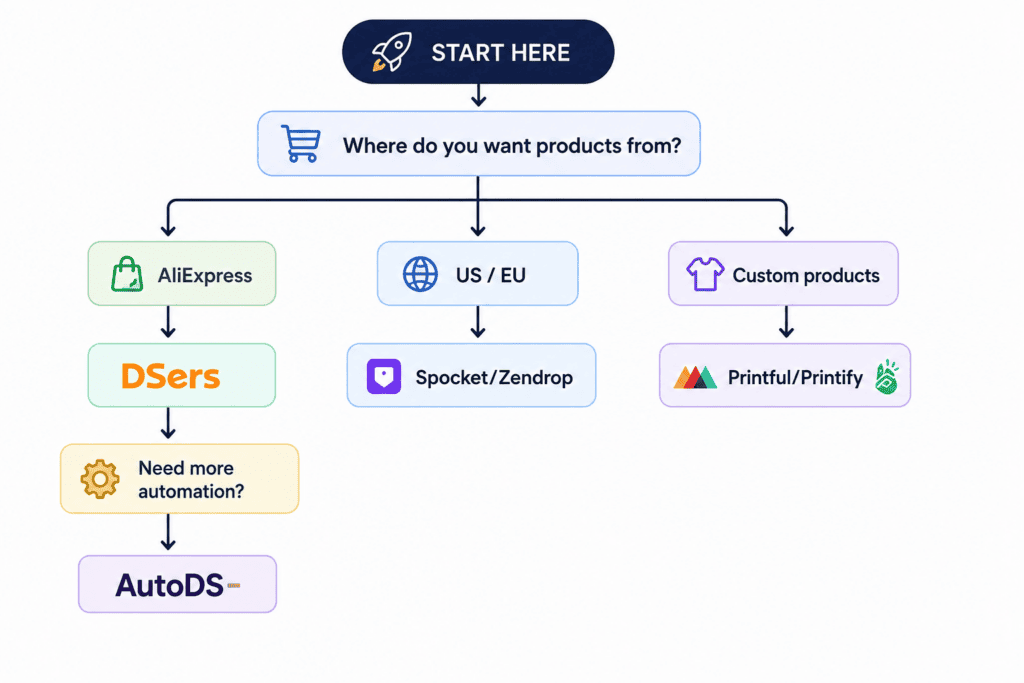
There isn’t much point paying for advanced features you won’t use.
If you’re testing your first few products, start simple. If you’re processing hundreds of orders, automation becomes much more important. And if you’re building a genuine brand rather than testing random products, supplier quality and fulfilment should probably matter more than having the largest catalogue.
Don't Choose a Dropshipping App Based on Product Count
This is where many new merchants get caught. An app showing 100,000 products might sound better than one showing 10,000. But how many of those products are actually relevant to your niche?
And how many have:
- Reasonable shipping times?
- Good product quality?
- Reliable stock?
- Enough profit margin?
- Useful product images?
- Accurate descriptions?
- Consistent supplier performance?
A smaller catalogue of reliable suppliers can be far more valuable than a huge catalogue of products you wouldn’t want to sell anyway.
A Simple Dropshipping App Checklist
Before committing to any of these dropshipping apps, run it through this checklist:
- Supplier quality: Can you identify who actually fulfils the order?
- Delivery: How long will your customers realistically wait?
- Product margins: After product cost, shipping, Shopify fees, advertising and refunds, is there still enough profit?
- Automation: What does the app actually automate?
- Inventory: Does stock update automatically?
- Order tracking: Can customers receive useful tracking information?
- Branding: Can you customise packaging, invoices or the customer experience?
- Scalability: Will the app still work when your store goes from 10 orders a month to 1,000?
That last question is particularly important.
The best app for a store making its first few sales might not be the best app for a store processing hundreds of orders every month.
Final Verdict: What's the Best Dropshipping App for Shopify?
If you’re looking for a straightforward starting point, DSers is one of the strongest options for AliExpress-based dropshipping, particularly if you want to test products without immediately committing to a large software bill.
For merchants who want heavier automation, AutoDS is worth exploring. If fulfilment, branding and US-based sourcing are higher priorities, Zendrop becomes more interesting. For regional supplier networks, Spocket and Syncee are worth considering, while Printful and Printify make more sense for print-on-demand businesses.
The important thing is not to install every app on this list. Start with the one that fits your business model, test the supplier experience, calculate your actual margins and only add more tools when you have a reason to. Because ultimately, the best Shopify dropshipping app isn’t the one with the longest feature list. It’s the one that makes your particular store easier to run and more profitable to grow.

 Matt
Matt