
Introduction
Shopify makes it possible to launch an online store quickly, but creating a store that truly reflects your brand and meets your customers’ expectations often requires more than choosing a theme and adding products. Shopify customisation allows businesses to adapt their online stores around their unique branding, customer journeys and operational requirements.
From customising themes and layouts to adding advanced functionality and third-party integrations, there are many ways to create a more flexible and engaging Shopify store. Whether you are launching a new ecommerce business or improving an established store, the right Shopify customisation approach can help create a shopping experience that is more aligned with your business goals.
What Is Shopify Customisation?
Shopify customisation refers to modifying and adapting a Shopify store to meet specific design, functionality and business requirements. This can range from simple changes to colours, fonts and layouts to advanced development involving custom features, integrations and bespoke ecommerce experiences.
The level of customisation required depends on the business. Some stores may only need adjustments to an existing theme, while others may require extensive development to support complex customer journeys or unique operational processes.
Basic Shopify Customisation
Basic customisation typically involves making changes through Shopify’s built-in tools or theme editor. Businesses can adjust elements such as colours, typography, images, layouts and sections to create a more branded storefront without making extensive code changes.
Theme-Level Customisation
Shopify theme customisation goes further by modifying the structure and design of an existing theme. This can include creating custom sections, changing page layouts, adapting product templates and improving the overall user experience while maintaining the foundation of the selected theme.
Advanced Shopify Customisation
Advanced Shopify customisation involves developing bespoke functionality that may not be available through Shopify’s standard features or existing apps. This can include custom integrations, tailored shopping experiences, specialised product functionality and solutions designed around specific business requirements.
Why Customise Your Shopify Store?
A standard Shopify setup can be an excellent starting point, but every ecommerce business has different goals, products and customers. Customising your Shopify store allows you to create an experience that is built around your specific brand and audience rather than relying entirely on a standard template.
One of the biggest advantages for shopify developers is the ability to create a stronger brand identity. Custom layouts, colours, typography and visual elements can make your store feel distinctive and consistent across the customer journey.
Customisation can also support specific business requirements. Whether you need advanced product functionality, a bespoke integration or a unique customer experience, Shopify can be adapted to accommodate a wide range of ecommerce needs.
What Can You Customise on Shopify?
One of the biggest advantages of Shopify is the flexibility it offers businesses to customise different parts of their online store. Depending on your requirements, customisation can focus on visual design, functionality, user experience or integrations.
Shopify Theme and Store Design
Shopify theme customisation allows businesses to create a storefront that reflects their visual identity. This can include changing layouts, colours, typography, imagery, buttons, banners and other design elements.
An existing Shopify theme can also be adapted to create custom sections and page structures that are more relevant to the brand. This allows businesses to maintain a consistent visual experience while creating a store that feels less generic.
Homepage and Landing Pages
The homepage is often the first major touchpoint between a customer and an ecommerce brand. Shopify homepage customisation can help businesses present their products, offers and value propositions in a more engaging way.
Custom landing pages can also be created for marketing campaigns, seasonal promotions, specific product categories or paid advertising campaigns. A tailored landing page can provide a more focused experience based on the customer’s intent.
Product and Collection Pages
Product and collection pages play an important role in helping customers discover and evaluate products. These pages can be customised to present information in a way that is relevant to the business and its audience.
Custom product page layouts, additional product information, promotional elements, product recommendations and tailored content can all contribute to a more effective shopping experience.
Navigation and Store Structure
A well-organised store makes it easier for customers to find what they are looking for. Shopify website customisation can include adapting menus, category structures, filters and navigation elements to improve product discovery.
For stores with large product catalogues, custom navigation and filtering can be particularly valuable. The goal is to reduce friction and help customers move through the store more efficiently.
Cart and Shopping Experience
The shopping cart is an important stage of the customer journey. Shopify cart customisation can be used to present relevant information, product recommendations, promotional messaging or additional options before checkout.
Businesses can tailor the cart experience to encourage customers to review their orders and discover relevant products without creating unnecessary distractions.
Custom Features and Functionality
Some businesses require features that are not available through Shopify’s standard functionality. Custom Shopify features can be developed to support specific requirements and create a more tailored ecommerce experience.
Depending on the business, this could include custom product options, advanced pricing logic, specialised product builders, bespoke customer experiences or other functionality designed around unique requirements.
Integrations and Third-Party Systems
Ecommerce stores often need to connect with other platforms and systems. Shopify can be integrated with tools such as enterprise resource planning systems, customer relationship management platforms, payment providers, marketing tools and fulfilment solutions.
Custom Shopify integrations can help businesses connect their ecommerce operations and reduce manual processes while ensuring that information flows efficiently between different systems.
Shopify Theme Customisation vs Custom Shopify Development
Shopify theme customisation and custom Shopify development are related but serve different purposes.
Theme customisation generally focuses on adapting the appearance and structure of an existing Shopify theme. It can involve modifying layouts, creating custom sections, adjusting page templates and improving the visual experience.
Custom Shopify development is typically used when a business requires functionality or experiences that go beyond what can be achieved through standard theme changes. This may involve bespoke features, custom integrations, advanced functionality or tailored ecommerce workflows.
| Shopify Theme Customisation | Custom Shopify Development |
| Focuses mainly on design and storefront experience | Focuses on advanced functionality and business requirements |
| Modifies an existing theme | Can involve bespoke solutions |
| Suitable for layout and visual changes | Suitable for complex features |
| Can include custom sections and templates | Can include custom integrations and functionality |
| Often suited to standard ecommerce requirements | Suited to unique or complex requirements |
The right approach depends on the needs of the store. Some businesses may only require theme-level changes, while others may benefit from a combination of theme customisation and custom development.
Shopify Customisation Ideas to Improve Your Online Store
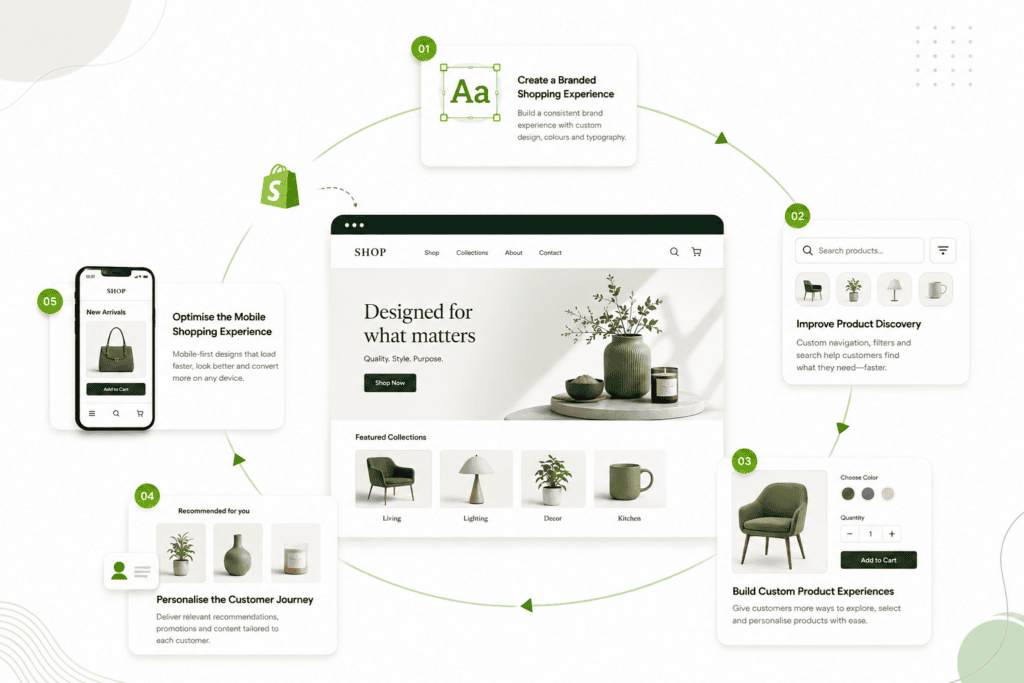
Shopify customisation is not only about making a store look different. It can also be used to improve how customers interact with the website and make the overall shopping experience more effective.
Create a Branded Shopping Experience
A consistent visual identity can help customers recognise and remember your brand. Customising the storefront around your brand’s colours, typography, imagery and messaging can create a more cohesive experience.
Improve Product Discovery
Customers should be able to find relevant products quickly. Custom navigation, filtering, search functionality and collection structures can make it easier for visitors to browse large catalogues.
Build Custom Product Experiences
Some products require more information or configuration than a standard product page can provide. Custom product experiences can allow customers to explore options, select variations or understand products more clearly before making a purchase.
Personalise the Customer Journey
Businesses can customise different parts of the shopping journey to make the experience more relevant. This may include tailored product recommendations, promotional content or customer-specific experiences.
Optimise the Mobile Shopping Experience
A significant proportion of ecommerce traffic comes from mobile devices. Shopify customisation should therefore consider how layouts, menus, product pages and purchasing journeys work across different screen sizes.
A mobile-first approach can help create a smoother experience for customers and reduce friction throughout the shopping journey.
Custom Shopify Features for Different Ecommerce Businesses
Different types of ecommerce businesses may require different approaches to Shopify customisation. A feature that works well for one business may not be relevant to another.
Shopify Customisation for Fashion and Apparel
Fashion brands may benefit from custom product displays, size guides, product recommendations, visual navigation and engaging collection pages. The focus is often on presenting products in a visually compelling way while making browsing simple.
Shopify Customisation for B2B Businesses
B2B ecommerce businesses may have more complex requirements, including customer-specific pricing, account functionality, bulk ordering and tailored purchasing processes. Shopify customisation can help create experiences that better support business buyers.
Shopify Customisation for Beauty and Cosmetics
Beauty brands may use customisation to highlight product benefits, ingredients, routines and recommendations. Custom product experiences can help customers make more informed purchasing decisions.
Shopify Customisation for Home and Furniture
Furniture and homeware businesses may need detailed product information, dimensions, delivery details and visual merchandising. Customised product and collection experiences can help customers explore products more effectively.
Shopify Customisation for Other Ecommerce Businesses
From electronics and accessories to food and lifestyle products, Shopify can be adapted to support different catalogues and customer journeys. The best approach depends on the products, audience and objectives of the business.
Benefits of Customising Your Shopify Store
Investing in Shopify store customisation can provide several benefits beyond visual improvements.
A customised store can help establish a stronger and more recognisable brand identity. Instead of relying on a generic ecommerce experience, businesses can create a storefront that reflects their positioning and personality.
Customisation can also improve the customer experience by making navigation, product discovery and purchasing more intuitive. A well-structured store can help customers find the information they need and move through the buying journey with less friction.
Another benefit is flexibility. As a business grows, its ecommerce requirements may change. A customised Shopify store can provide greater flexibility to adapt to new products, customer requirements and operational processes.
Customisation can also help businesses differentiate themselves in competitive markets by creating experiences that are more relevant to their target audience.
How Much Does Shopify Customisation Cost?
The cost of Shopify customisation can vary significantly depending on the scope and complexity of the project. There is no single price that applies to every Shopify store because each business has different requirements.
Basic theme changes and visual adjustments are generally less complex than advanced custom Shopify development. The cost can increase when a project requires custom functionality, third-party integrations, bespoke designs or complex ecommerce workflows.
Other factors that can influence the cost include the number of templates being customised, the complexity of the existing store, the number of integrations required and whether ongoing maintenance is needed.
Before starting a Shopify customisation project, it is useful to define the required features, business objectives and expected customer experience. This makes it easier to determine the right approach and develop a realistic project scope.
Common Shopify Customisation Mistakes to Avoid

Customisation can improve a Shopify store, but it needs to be approached strategically. Making changes without considering the overall customer journey can create unnecessary complexity.
Over-Customising Your Store
Not every part of a Shopify store needs to be customised. Adding unnecessary features can make a website more complicated without providing meaningful value to customers.
Ignoring Mobile Experience
A store that looks good on desktop but performs poorly on mobile can create a frustrating experience. Every customisation should be tested across different screen sizes and devices.
Adding Too Many Apps
Installing too many Shopify apps can create conflicts, slow down the store and make maintenance more difficult. Businesses should focus on selecting solutions that genuinely support their goals.
Focusing on Design Over Usability
A visually impressive website is not necessarily an effective ecommerce store. Design decisions should always support usability, navigation and the customer’s ability to complete their purchase.
Not Planning for Future Growth
Customisation should consider the long-term needs of the business. Solutions that work today may become restrictive as product catalogues, traffic and operational requirements grow.
How Kiwi Commerce Helps Businesses Customise Shopify Stores
At Kiwi Commerce, we help businesses create Shopify stores that are tailored to their brand, customers and ecommerce requirements. From Shopify theme customisation to advanced development, our approach focuses on creating experiences that combine design, usability and functionality.
Our Shopify customisation capabilities can include theme modifications, custom storefront experiences, bespoke functionality, third-party integrations and Shopify Plus solutions. We can also support businesses looking to improve existing stores or build more tailored ecommerce experiences from the ground up.
The goal is not simply to customise a Shopify store for the sake of adding features. It is about understanding the business and creating an ecommerce experience that supports its objectives, provides a better customer journey and can adapt as the business grows.
Whether you need targeted theme customisation or a more complex Shopify development solution, the right level of customisation can help your store stand out and deliver a more effective shopping experience.

 Alex
Alex