
Introduction
Choosing the right eCommerce platform is one of the most important decisions for any growing business. It shapes how you sell, how customers experience your brand, and how easily you can scale in the future. When comparing enterprise-level platforms, the conversation often comes down to Magento vs Oracle Commerce.
Both platforms are powerful, widely used, and capable of supporting complex operations. However, they are built with different priorities in mind. Magento focuses on flexibility and customisation, while Oracle Commerce leans towards enterprise-grade automation and seamless integration with business systems.
In this guide, we’ll explore key differences, similarities, and factors to consider when comparing Oracle Commerce Cloud vs Magento so you can decide which one fits your business best.
Oracle Commerce vs Magento – An Overview
At a glance, Magento and Oracle Commerce serve different types of businesses, even though there is some overlap.
| Platform | Ideal For | Core Strength |
| Magento | Small to large businesses | Flexibility and control |
| Oracle Commerce | Large enterprises | Automation and integrations |
Magento is often preferred by businesses that want control over their store and the ability to customise every detail. Oracle Commerce, on the other hand, is designed for organisations that need a structured, enterprise-ready solution with built-in tools.
Oracle Commerce Overview
Oracle Commerce, also known as Oracle CX Commerce, is part of a broader ecosystem that includes CRM, ERP, and marketing tools. It is designed to handle complex business requirements at scale.
One of the main advantages of Oracle Commerce is that the platform provides configuration tools that allow businesses to manage operations without constantly relying on development teams. It also offers strong built-in automation, which helps streamline workflows and reduce manual effort.
Another key strength is its ability to integrate seamlessly with other enterprise systems. For businesses already using Oracle products, this creates a unified environment where data flows smoothly across departments.
Magento Overview
Magento, now part of Adobe Commerce, is one of the most flexible eCommerce platforms available. It offers both an open-source version and a premium enterprise edition, making it suitable for businesses of different sizes.
What sets Magento apart is its adaptability. Whether you want to build a simple online store or a highly complex eCommerce ecosystem, Magento allows you to customise almost everything. This includes design, functionality, and integrations.
Many businesses choose to work with a Magento development company to get the most out of the platform, especially when building tailored features or scaling operations. Its large community and extensive marketplace also make it easier to extend functionality without starting from scratch.
Oracle Commerce vs Magento – Which One Should You Choose?
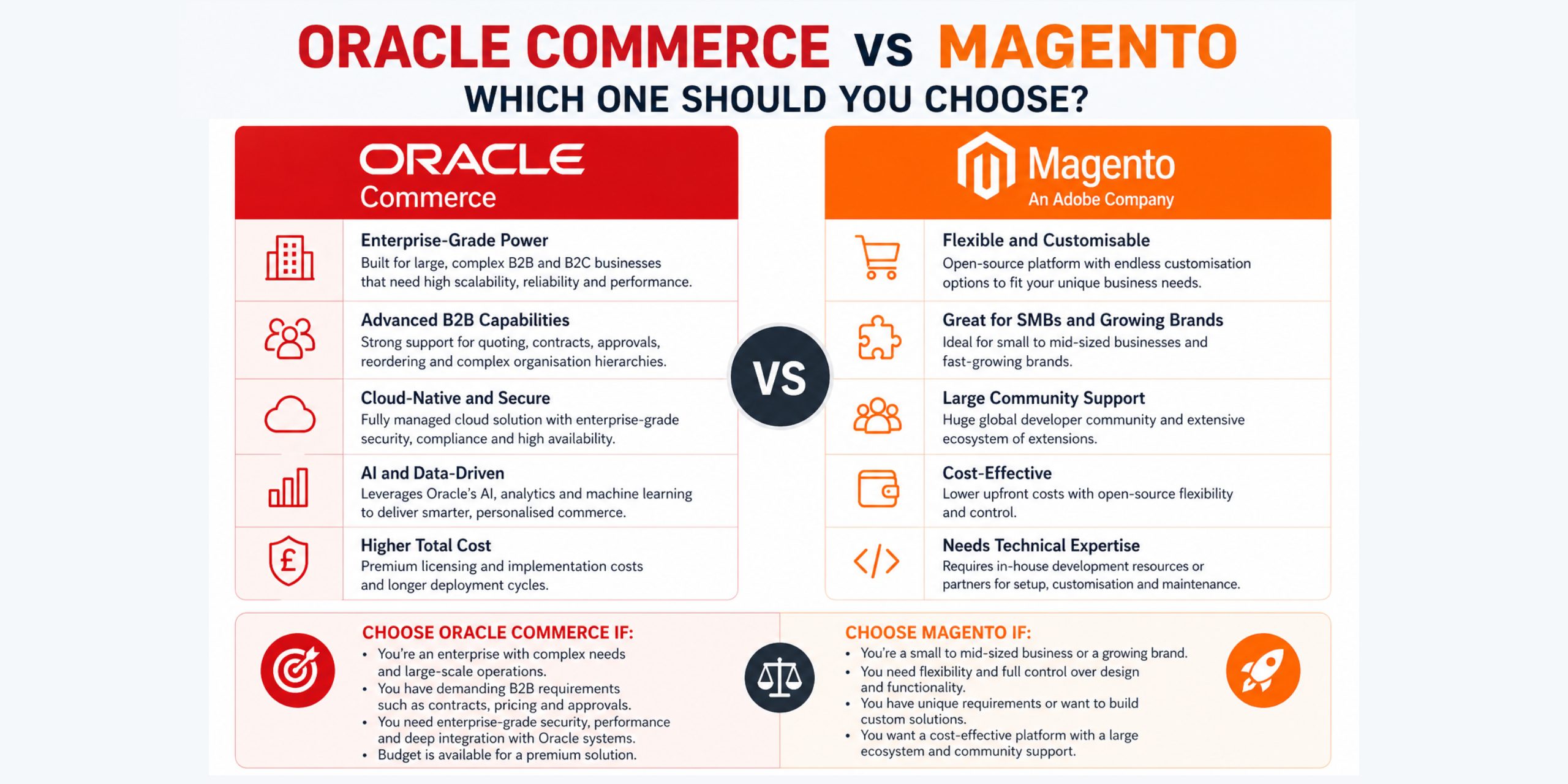
Deciding between Magento vs oracle cx depends largely on your business goals and technical requirements.
Magento is often the better choice for businesses that want flexibility and control. It allows you to build exactly what you need and adapt quickly as your business evolves. This makes it particularly appealing for growing brands and mid-sized companies.
Oracle Commerce is better suited for large enterprises that prioritise stability, automation, and integration. If your business relies heavily on complex workflows or multiple enterprise systems, Oracle Commerce provides a more structured environment.
Oracle Commerce vs Magento – All The Key Differences
A closer comparison highlights where each platform stands.
Cost of Ownership
| Factor | Magento | Oracle Commerce |
| Initial Cost | Lower | High |
| Ongoing Cost | Moderate | High |
Magento offers more control over costs, while Oracle Commerce requires a significant upfront investment.
Ease of Use
Magento requires technical knowledge, especially for customisation. Oracle Commerce is more structured but can feel complex due to its enterprise nature.
B2B Features
Both platforms support B2B functionality, but Oracle Commerce provides more advanced built-in tools, while Magento relies on modules and extensions.
Inventory Management
Magento offers flexibility through extensions, whereas Oracle Commerce includes advanced inventory capabilities as part of its core system.
Payment Gateways
Magento supports a wide range of payment gateways through integrations. Oracle Commerce supports enterprise-grade options but with less flexibility.
Customisation Options
Magento stands out for its unmatched customisation capabilities. Oracle Commerce offers controlled customisation within its framework.
Security & Compliance
Both platforms are secure, but Oracle Commerce places a stronger emphasis on enterprise compliance standards.
Support
Magento offers community and paid support options. Oracle Commerce provides dedicated enterprise support.
Performance & Scalability
Both platforms are scalable, though Oracle Commerce is built specifically for large-scale operations.
Integration Ecosystem
Magento has a vast extension marketplace. Oracle Commerce focuses on deep integrations with enterprise systems.
SEO & Marketing
Magento offers strong SEO flexibility, while Oracle Commerce provides built-in marketing tools.
Developer Experience
Magento is developer-friendly and widely supported. Oracle Commerce requires specialised expertise.
Analytics & Reporting
Magento relies on extensions, while Oracle Commerce includes advanced analytics as part of its ecosystem.
Detailed Feature Comparison & Technical Insights
Total Cost Breakdown (Including Hidden Costs)
| Cost Area | Magento | Oracle Commerce |
| Licensing | Free / Paid | Premium |
| Development | Flexible | High |
| Maintenance | Ongoing | Managed but costly |
Magento allows businesses to scale spending gradually, whereas Oracle Commerce involves higher long-term commitments.
Hosting & Deployment Options
Magento supports multiple hosting options, including cloud and on-premise setups. Oracle Commerce is primarily cloud-based, which simplifies infrastructure but reduces flexibility.
Headless Commerce Capabilities
Magento is particularly strong in headless commerce. Businesses looking for modern, API-driven experiences often explore Magento headless commerce to build fast and flexible frontends.
Time to Market
Magento can be quicker to launch, especially with pre-built extensions. Oracle Commerce typically takes longer due to its enterprise setup and configuration requirements.
Maintenance & Ongoing Effort
Magento requires regular updates and technical management. Oracle Commerce offers a more managed environment but comes with higher costs.
Third-Party Extensions & Marketplace
Magento benefits from a large ecosystem of extensions. Oracle Commerce has fewer options but focuses on high-quality integrations.
User Experience (Admin & Customer)
Magento allows businesses to tailor both admin and customer experiences. Oracle Commerce provides a consistent but less flexible interface.
Migration & Switching Complexity
Migrating to Magento is generally more straightforward. Moving to Oracle Commerce can be complex and resource-intensive.
Future Scalability & Roadmap
Magento offers flexibility for scaling in different directions. Oracle Commerce is built for enterprises with long-term growth plans.
Pros & Cons Summary
Magento is known for its flexibility, cost efficiency, and strong community support. However, it requires ongoing development and maintenance efforts. Oracle Commerce excels in automation, integration, and enterprise readiness, but comes with higher costs and complexity.
Implementation Time
| Platform | Estimated Timeline |
| Magento | 2–6 months |
| Oracle Commerce | 6–12+ months |
Who Should Choose Magento vs Oracle Commerce?
Magento is a strong fit for startups, small to medium-sized businesses, and even large companies that value flexibility. Businesses that want to build unique experiences or scale gradually often benefit from Magento.
Oracle Commerce is better suited for large enterprises with complex requirements, multiple integrations, and the need for built-in automation. It is particularly valuable for organisations already invested in the Oracle ecosystem.
Working with a Magento web development agency or choosing to hire Magento developers can help businesses unlock the full potential of Magento and ensure a smooth implementation.
Final Verdict
When comparing Oracle Commerce vs Magento 2, the decision ultimately comes down to your priorities.
Magento offers flexibility, control, and a cost-effective way to scale. Oracle Commerce provides a structured, enterprise-grade solution with powerful automation and integration capabilities.
If your focus is on agility and customisation, Magento is the better option. If your priority is enterprise-level efficiency and seamless system integration, Oracle Commerce is worth the investment.

 Krish
Krish