
Introduction
Artificial intelligence is changing ecommerce from the way customers discover products to how businesses manage orders, personalise experiences and make decisions. What started with basic automation, product recommendations and chatbots is moving towards something much more advanced: agentic commerce. Agentic commerce brings AI agents into the ecommerce journey. Instead of simply responding to a customer request or generating a recommendation, AI agents can understand an objective, evaluate options, make decisions and take actions on behalf of customers or businesses.
For ecommerce brands, this could mean more personalised shopping journeys, intelligent customer service, automated operations and AI-powered decision-making across the entire customer lifecycle. As businesses explore AI for ecommerce, understanding agentic commerce can help them prepare for the next stage of digital commerce.
What Is Agentic Commerce?
Agentic commerce refers to an ecommerce model where AI agents can independently perform tasks and make decisions within a shopping or commercial journey.
Traditional ecommerce generally requires customers to navigate a website, search for products, compare options, add items to a basket and complete the checkout process themselves.
AI can change that journey. An AI agent could understand what a customer wants, identify suitable products, compare options, consider preferences and potentially complete parts of the purchasing journey. The agent could interpret the requirements, evaluate available products and present the most relevant options.
This is the fundamental idea behind agentic commerce: AI doesn’t just provide information; it can help move the customer towards an outcome.
The Role of AI in Ecommerce
AI ecommerce is already influencing many parts of the online shopping experience. Businesses use artificial intelligence to analyse customer behaviour, personalise recommendations, automate support and improve operational decision-making.
Some of the most common applications of artificial intelligence in e-commerce include:
- Product recommendations based on browsing and purchasing behaviour
- AI-powered search and product discovery
- Personalised website experiences
- Automated customer support
- Demand forecasting
- Inventory optimisation
- Fraud detection
- Dynamic pricing
- Marketing automation
- Product content generation and optimisation
These applications can make ecommerce more efficient while helping customers find relevant products more quickly.
However, many traditional AI systems still operate within predefined workflows. Agentic AI takes the concept further by allowing systems to reason through a task and determine the actions required to complete it.
From AI-Powered Ecommerce to Agentic Commerce
The difference between conventional AI-powered ecommerce and agentic commerce is largely about action and autonomy.
A traditional AI system might analyse a customer’s behaviour and recommend a product.
An agentic system could potentially:
- Understand the customer’s requirements.
- Search through available products.
- Compare products against those requirements.
- Consider price, availability and delivery.
- Ask for clarification when necessary.
- Recommend the best options.
- Take an approved action.
This doesn’t mean every ecommerce process will become fully autonomous. Human approval, business rules, security and customer preferences will remain important.
Instead, agentic commerce creates the possibility of AI becoming an active participant in the ecommerce journey.
How Agentic Commerce Can Transform the Shopping Experience
AI-Powered Product Discovery
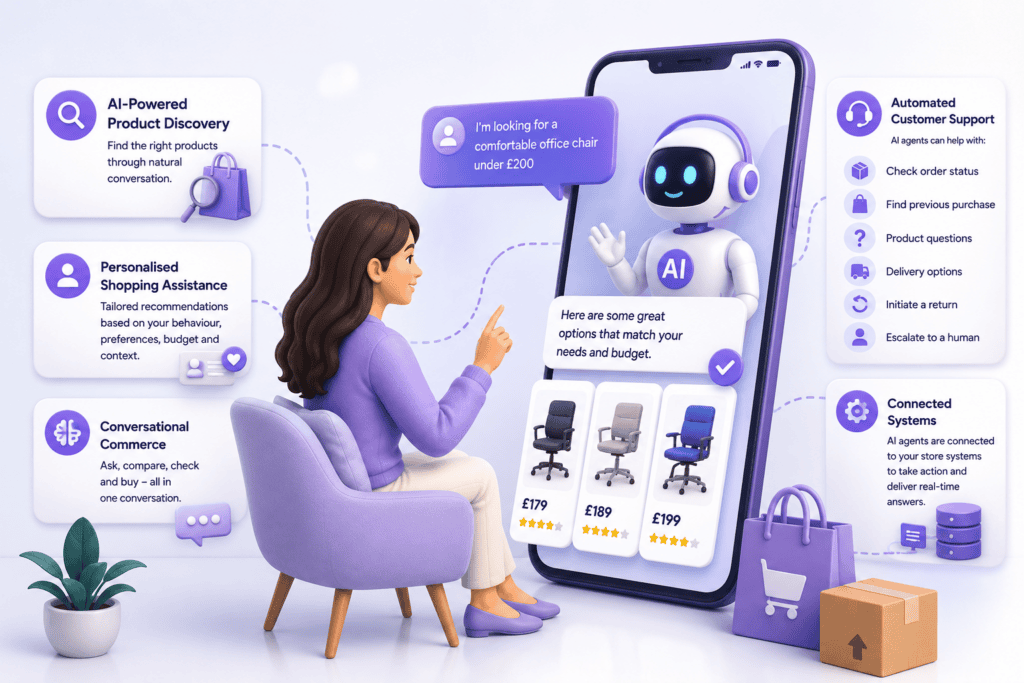
Product discovery is one of the most obvious areas where agentic AI can change ecommerce. Traditional ecommerce search often relies on keywords and filters. Customers need to know what they are looking for and how to describe it. AI agents can make product discovery more conversational.
A customer could explain their needs, preferences, budget and intended use rather than entering a short keyword-based query. The AI can then interpret the request and identify products that match the customer’s requirements. This could be particularly valuable for large ecommerce catalogues where customers can otherwise become overwhelmed by thousands of products.
Personalised Shopping Assistance
Personalisation has been an important part of ecommerce for years, but AI can make it more dynamic. Instead of showing the same recommendations to every customer, AI agents can consider a combination of factors such as:
- Previous purchases
- Browsing behaviour
- Stated preferences
- Budget
- Product requirements
- Current context
- Availability
- Previous interactions
The result can be a shopping experience that feels more like speaking to a knowledgeable sales assistant than navigating a traditional online store.
Conversational Commerce
AI-powered conversational interfaces can help customers move through multiple stages of the buying journey. A customer could ask about a product, compare alternatives, check availability, understand delivery options and ask about returns within the same conversation. Rather than forcing customers to move between product pages, FAQs and support channels, an AI agent can potentially bring these interactions together.
Automated Customer Support
AI for ecommerce is also changing customer service. Basic chatbots typically answer predefined questions. Agentic systems could potentially understand more complex requests and perform actions across connected systems. For example, an AI agent might help a customer:
- Check an order status
- Find a previous purchase
- Identify a replacement product
- Answer product questions
- Explain delivery options
- Initiate a return
- Escalate a complex issue to a human
The key is the connection between the AI agent and the ecommerce systems behind the customer experience.
How AI Can Transform Ecommerce Operations
Agentic commerce isn’t only about customers. AI agents could also help ecommerce teams manage repetitive and data-heavy processes.
Inventory and Demand Forecasting
AI can analyse historical sales, seasonal patterns, product performance and other business data to help identify potential inventory requirements. Agentic systems could take this further by monitoring predefined conditions and initiating appropriate workflows. For example, an agent could identify that a high-demand product is approaching a stock threshold, investigate sales trends and notify the relevant team or initiate an approved replenishment process.
Marketing Automation
AI agents could also support ecommerce marketing. Instead of simply generating an email or advertising copy, an agent could analyse campaign performance, identify opportunities and suggest or execute actions according to predefined rules.
Potential applications include:
- Customer segmentation
- Campaign optimisation
- Personalised promotions
- Product recommendations
- Email marketing
- Retargeting
- Content optimisation
Human oversight would remain important, particularly when agents are allowed to make decisions that affect customers or advertising spend.
Product Content Management
Large ecommerce stores can have thousands of products, making product content management a significant task. I can help generate, analyse and improve product descriptions, attributes, categorisation and other product information. Agentic workflows could potentially identify incomplete product data, determine what information is missing and trigger the appropriate workflow to improve it.
AI Search and the Changing Ecommerce Customer Journey
Another important change is happening before customers even reach an ecommerce website. Customers are increasingly using conversational AI and AI-powered search to research products, compare options and answer questions. This means ecommerce businesses need to think beyond traditional search rankings and consider whether their product and brand information can be clearly understood by AI systems.
Kiwi Commerce’s guide to LLM SEO explores how businesses can structure information around context, meaning, entities and search intent so that it is easier for AI systems to understand. For ecommerce businesses, this is particularly important because product discovery may increasingly happen through AI interfaces rather than only through traditional search results.
Why LLM SEO Matters for Agentic Commerce
Agentic commerce depends on information. An AI agent needs to understand what a business sells, what its products offer, how products differ, what is available, how delivery works and what policies apply. If this information is incomplete, inconsistent or difficult to interpret, an AI agent has less reliable context to work with. This makes clear ecommerce content increasingly important.
Product descriptions, specifications, categories, FAQs, policies and supporting content should all communicate information clearly and consistently. Strong traditional SEO remains important as well. Technical accessibility, internal linking, structured data, authority and high-quality content can all contribute to how effectively ecommerce information is discovered and understood.
Where Does llms.txt Fit Into Agentic Commerce?
Another emerging consideration is llms.txt. An llms.txt file is designed as a curated, AI-friendly resource that points AI systems towards important information on a website. It is different from robots.txt, which controls crawler access, and from sitemap.xml, which provides a broader list of URLs. For ecommerce websites, an llms.txt file can be used to organise links to important areas such as:
- Product information
- Key categories
- Ecommerce services
- FAQs
- Shipping information
- Returns policies
- Buying guides
- Important documentation
It is important not to overstate its role. Major consumer AI platforms have not universally confirmed that they use llms.txt as a ranking or answer-generation signal. However, the concept is relevant to the wider agentic web, where AI agents, developer tools and retrieval systems can use structured information to understand websites.
If you’re considering implementing it, see Kiwi Commerce’s llms.txt setup guide for WordPress, Shopify, Magento and custom websites for practical implementation guidance.
Agentic Commerce and Magento & Shopify
For agentic commerce to work effectively, AI needs access to reliable ecommerce data and the ability to interact with the systems that manage the store. This is where ecommerce platforms such as Magento and Shopify can become important parts of an AI-enabled commerce architecture.
AI agents may need to interact with information such as:
- Product catalogues
- Customer profiles
- Product availability
- Pricing
- Orders
- Shipping information
- Promotions
- Inventory
- Customer support data
APIs, integrations and custom development can connect AI capabilities with these underlying ecommerce systems. For businesses using Magento or Shopify, the opportunity isn’t necessarily about replacing the ecommerce platform with AI. Instead, AI can become an additional intelligence layer that works with the existing commerce infrastructure.
This can allow businesses to introduce AI-powered functionality while continuing to use the ecommerce platform that manages their products, customers and transactions.
Benefits of Agentic Commerce for Ecommerce Businesses
The potential benefits of agentic commerce extend across both customer experience and business operations.
More Personalised Experiences
AI agents can consider individual customer requirements and context to provide more relevant interactions.
Faster Product Discovery
Customers can describe what they need naturally instead of navigating complex product catalogues and filters.
Greater Operational Efficiency
AI agents can automate repetitive processes and reduce the amount of manual work required by ecommerce teams.
Improved Customer Support
AI-powered systems can handle common requests while allowing human teams to focus on more complex customer issues.
More Intelligent Decision-Making
AI can process large amounts of ecommerce data and help businesses identify trends, opportunities and potential problems.
Scalable Commerce
As an ecommerce business grows, AI can help handle increasing volumes of customer interactions and operational tasks without requiring every process to scale linearly with headcount.
Challenges of Implementing Agentic AI in Ecommerce
Agentic commerce also introduces new challenges. Businesses need to think carefully about what AI agents are allowed to access and what actions they can perform. Security, privacy, data quality and human oversight are particularly important. An AI agent that can recommend a product is very different from an AI agent that can change an order, issue a refund or make a purchase.
Businesses therefore need clear rules around:
- Permissions
- Data access
- Customer privacy
- Human approval
- Security
- Error handling
- Monitoring
- Auditability
The goal should not be to give AI unlimited control. Instead, businesses should determine where autonomous actions can create value and where human approval should remain part of the process.
How Ecommerce Businesses Can Prepare for Agentic Commerce
You don’t need to build a fully autonomous ecommerce store today to prepare for agentic commerce. Start with the foundations.
1. Improve Your Product Data
Make product names, descriptions, attributes, specifications, availability and pricing clear and consistent.
2. Build Strong Ecommerce Infrastructure
Your ecommerce platform should be able to communicate reliably with other systems through APIs and integrations.
3. Strengthen Your Content
Create useful content that answers customer questions around products, categories, comparisons and purchasing decisions.
4. Optimise for AI Discovery
Consider how AI systems interpret your website, brand, products and expertise. This includes traditional SEO as well as emerging approaches such as LLM SEO.
5. Organise Important Information
Make important business information easy to find and understand. This includes product data, policies, FAQs and supporting documentation.
6. Explore AI Workflows
Rather than trying to automate everything, identify repetitive ecommerce processes where AI could assist your team or customers.
7. Keep Humans in the Loop
Define which decisions AI can make independently and which require human approval.
The Future of Agentic Commerce
Ecommerce has traditionally placed the website at the centre of the shopping journey. The customer visits a store, searches for products, compares options and completes the purchase. Agentic commerce could introduce a different model. Instead of:
Customer → Search → Ecommerce Website → Product → Checkout
we could increasingly see:
Customer → AI Agent → Product Discovery → Ecommerce Platform → Transaction
The ecommerce website will still matter. But AI agents may increasingly become an interface between customers and commerce platforms.
This could change how businesses think about product discovery, customer experience, content, APIs, product data and digital marketing.
For ecommerce businesses, the opportunity is not simply to “add AI”. It is to build an infrastructure that allows AI to work effectively alongside their existing commerce systems.
Final Thoughts
AI is already changing ecommerce, but agentic commerce represents a potentially bigger shift.
The next generation of AI for ecommerce will go beyond recommendations and automated responses. AI agents could increasingly understand customer needs, evaluate information, coordinate tasks and take actions across the ecommerce journey.
For businesses, preparing for this future means getting the fundamentals right today: high-quality product data, strong ecommerce infrastructure, useful content, reliable integrations and a website that communicates information clearly.
Whether you’re running Magento, Shopify or a custom ecommerce platform, the foundations you build now can make it easier to introduce increasingly sophisticated AI capabilities as the technology develops.

 Anna
Anna