
Introduction
Choosing the right Shopify plan isn’t simply about finding the lowest monthly subscription. The real cost of running an online store includes payment processing, apps, themes, domains, email hosting and ongoing development. Understanding these costs from the beginning helps you avoid surprises as your business grows.
Whether you’re launching your first ecommerce website or managing an established retail brand, Shopify continues to be one of the most popular ecommerce platforms in the UK. Its flexible pricing structure means there’s a plan for almost every stage of business growth, from social sellers to enterprise retailers processing thousands of orders each month.
In this guide, we’ll explain everything you need to know about Shopify pricing UK, including what’s included with each plan, hidden costs to budget for, transaction fees, Shopify Plus pricing and how to decide which plan offers the best value for your business.
If you’re planning a new Shopify store or redesigning an existing one, working with a professional Shopify development partner ensures your store is built correctly from day one. Kiwi Commerce offers end-to-end Shopify Development Services to help businesses launch, optimise and scale successful online stores.
Shopify Pricing Changes in 2026
Shopify has continued to refine its pricing model in 2026 by improving value across its standard plans while expanding enterprise features for Shopify Plus merchants.
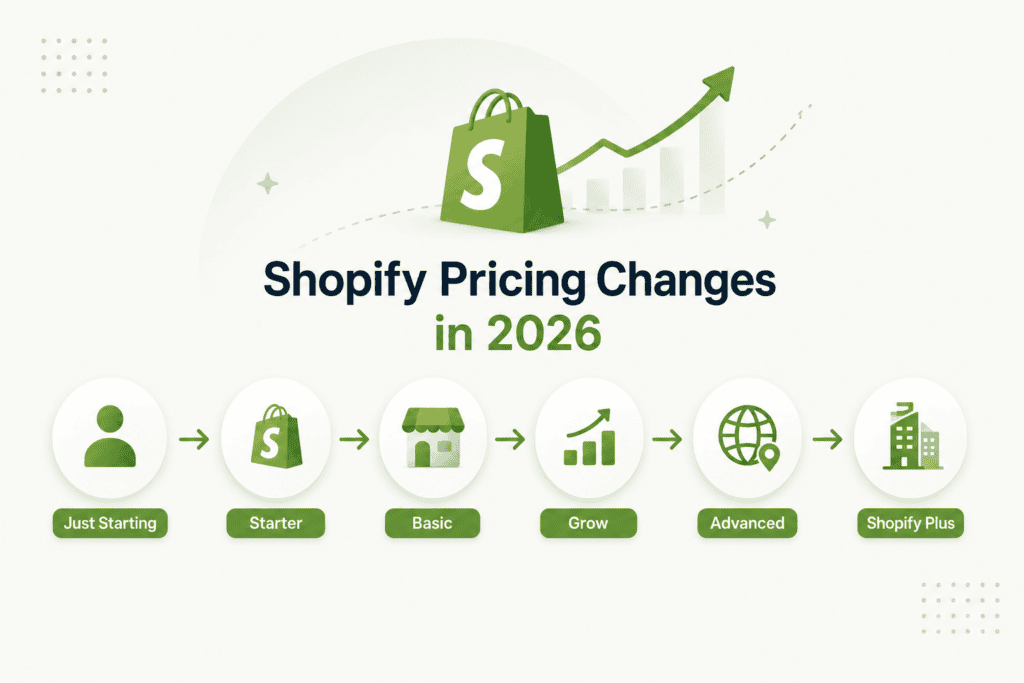
Today, Shopify offers five pricing plans in the UK, allowing merchants to scale as their business grows.
Shopify Plan Progression
👤 Just Starting ➜🛍️ Starter ➜ 🏪Basic ➜📈 Grow ➜🌍 Advanced ➜ 🏢 Shopify Plus
Each plan includes secure hosting, unlimited product listings, mobile responsiveness, SSL security and access to Shopify’s extensive App Store. As you move up the pricing tiers, you’ll benefit from lower payment processing fees, more advanced reporting, additional staff accounts and enhanced automation features.
Shopify Pricing Comparison (2026)
| Plan | Monthly Price* | Best For |
| Starter | £5 | Social selling and creators |
| Basic | £19–£25 | Start-ups and small businesses |
| Grow | From £49 | Growing ecommerce stores |
| Advanced | Higher monthly subscription | High-volume retailers |
| Shopify Plus | Custom pricing | Enterprise businesses |
*Prices may vary depending on whether you choose monthly or annual billing.
Shopify Starter Plan
The Shopify Starter Plan is designed for businesses that sell primarily through social media rather than a dedicated ecommerce website.
At just £5 per month, it’s an affordable way to accept payments, manage products and share purchase links across platforms like Instagram, TikTok and WhatsApp.
Best For
- Content creators
- Influencers
- Hobby businesses
- Social commerce
- Testing new products
What’s Included?
- Secure Shopify checkout
- Product catalogue
- Link-in-bio selling
- Order management
- Shopify Inbox
- Basic analytics
The Starter Plan doesn’t include a fully featured online storefront, making it better suited to businesses selling directly through social channels rather than relying on organic search or paid advertising.
Shopify Basic Plan
The Shopify Basic Plan remains the most popular option for new ecommerce businesses and answers the common question, “How much does Shopify cost UK?”
Typically priced between £19 and £25 per month, depending on your billing cycle, it provides all the essential tools needed to launch a professional online store.
Key Features
- Unlimited products
- Fully hosted ecommerce website
- Free SSL certificate
- Multiple sales channels
- Discount codes
- Customer accounts
- Basic reports
- 24/7 support
For many retailers, this plan offers the ideal balance between affordability and functionality. It supports businesses that are ready to move beyond social selling and establish a professional online presence.
As your store grows, it’s worth keeping performance in mind. Faster-loading websites improve user experience and can increase conversion rates. Kiwi Commerce helps businesses improve store speed through its Shopify Performance Optimisation service.
Shopify Grow Plan
The Grow Plan (formerly known as the Shopify Plan) is aimed at businesses experiencing steady growth and processing a higher volume of orders each month.

Starting from approximately £49 per month, it introduces improved reporting, lower payment processing rates and additional operational tools that help streamline day-to-day management.
Ideal For
- Growing ecommerce brands
- Businesses with larger catalogues
- Multi-person teams
- Stores expanding into international markets
Additional Benefits
- Professional reporting dashboards
- Lower payment processing fees
- More staff accounts
- Better inventory management
- Enhanced customer insights
- Improved automation capabilities
For businesses generating consistent monthly revenue, the savings on transaction fees alone can often justify the upgrade from the Basic Plan.
Shopify Advanced Plan
The Shopify Advanced Plan is designed for businesses that have outgrown the Grow plan and require greater control over operations, reporting and international selling. If your online store is processing hundreds or even thousands of orders each month, this plan can help improve efficiency while reducing payment processing costs.
Beyond the standard ecommerce features, the Advanced plan introduces custom reporting, enhanced analytics and shipping capabilities that are particularly useful for established retailers.
Best Suited For
- Established ecommerce brands
- Businesses selling internationally
- Retailers with large product catalogues
- Teams managing multiple sales channels
- Companies focused on data-driven growth
Key Features
- Advanced custom reports
- Lower credit card processing rates
- Third-party calculated shipping
- Duties and import tax calculations
- Enhanced analytics
- More staff accounts
- Improved international selling tools
Although the monthly subscription is higher than the Grow plan, many businesses recover the difference through lower Shopify fees UK and better operational efficiency.
Shopify Plus Pricing
For enterprise retailers, Shopify Plus offers far more than a standard ecommerce platform. It is designed for businesses managing high sales volumes, multiple storefronts, international markets and complex workflows.
Unlike the other Shopify plans, Shopify Plus pricing isn’t fixed. Instead, pricing is customised based on your business requirements, sales volume and operational complexity.
Who Should Consider Shopify Plus?
- Enterprise retailers
- Large D2C brands
- Wholesale (B2B) businesses
- Multi-brand organisations
- Businesses expanding globally
Shopify Plus Includes
- Customisable checkout
- Unlimited staff accounts
- Shopify Flow automation
- Launchpad for sales campaigns
- Wholesale (B2B) functionality
- Organisation management
- Higher API limits
- Dedicated Merchant Success Manager
- Multiple expansion stores
Business Growth Journey
💡 Business Idea ➜ 🛍️ Build Store ➜ 🚀 Launch Website ➜📈 Increase Sales
➜🌍 Expand Worldwide ➜ 🏢 Shopify Plus
For businesses planning rapid growth, Shopify Plus often delivers a lower total cost of ownership by automating repetitive tasks and reducing reliance on third-party tools.
If you’re considering moving to Shopify Plus, working with experienced specialists can simplify the transition. Kiwi Commerce’s Hire Shopify Plus Developers service helps businesses migrate, customise and optimise enterprise Shopify stores.
Shopify Monthly vs Annual Billing
One of the easiest ways to reduce your Shopify UK costs is by choosing annual billing instead of paying month by month.
Although monthly billing offers flexibility, annual subscriptions generally reduce your equivalent monthly cost and provide better long-term value.
Billing Comparison
| Billing Option | Best For | Overall Cost |
| Monthly | New businesses testing ideas | Higher monthly cost |
| Annual | Established businesses | Lower equivalent monthly cost |
If you know you’ll be using Shopify for at least a year, annual billing is usually the smarter financial decision.
Billing Decision Flow
Testing Your Business? → Yes → Monthly Billing
Established Store? → Yes → Annual Billing → Save More Each Year
What's Included in Shopify Plus Pricing?
While Shopify Plus has a higher subscription cost, it replaces several third-party solutions that growing businesses would otherwise pay for separately.
Some of the most valuable features include:
✔ Custom checkout experience
✔ Shopify Flow automation
✔ Launchpad event scheduling
✔ Advanced B2B selling tools
✔ Multiple expansion stores
✔ Enterprise-grade security
✔ Organisation management
✔ Priority support
✔ Higher API capacity
✔ Greater automation
For businesses operating across multiple countries, these features significantly reduce manual work while improving scalability.
What's NOT Included? (Additional Costs)
One of the biggest misconceptions about Shopify pricing UK is that the monthly subscription covers every expense involved in running an ecommerce business.
In reality, most successful online stores invest in additional tools and services to improve performance, marketing and customer experience.
Common Additional Costs
| Additional Expense | Typical Cost |
| Domain registration | Annual fee |
| Premium theme | One-time purchase |
| Shopify Apps | Monthly subscriptions |
| Email hosting | Monthly or annual |
| Professional design | Project-based |
| SEO services | Monthly |
| Development support | As required |
| Marketing tools | Monthly subscriptions |
These costs aren’t unique to Shopify they’re common across most ecommerce platforms but they should still be factored into your overall budget.
Transaction and Payment Fees
Your monthly subscription isn’t the only cost to consider. Every online sale also involves payment processing fees, and in some cases, additional transaction fees.
The exact amount you’ll pay depends on:
- Your Shopify plan
- Whether you use Shopify Payments
- The customer’s payment method
- Whether you’re selling domestically or internationally
Understanding Shopify Payments
Shopify Payments is Shopify’s own payment gateway and is the simplest way to accept online payments.
Benefits include:
- Faster payouts
- No third-party transaction fees (where applicable)
- Easy setup
- Integrated reporting
- Multiple payment methods
- Simplified reconciliation
If you choose to use an external payment gateway instead of Shopify Payments, Shopify may apply additional transaction charges depending on your subscription plan.
Transaction Cost Breakdown
🛒 Customer Orders ➜💳 Payment Processed ➜🏦 Processing Fee Applied ➜
💷 Remaining Balance Paid
Remaining Balance Paid to Merchant
Understanding how Shopify charges in the UK works allows businesses to forecast margins more accurately and choose the most cost-effective payment setup.
What Shopify Takes from a £100 Sale
One of the most common questions merchants ask is, “What percentage does Shopify take from a sale?” The answer depends on two factors: your subscription plan and the payment gateway you use.
If you’re using Shopify Payments, you’ll only pay the applicable card processing fee for your plan. If you choose a third-party payment provider, Shopify may also charge an additional transaction fee.
Example: A £100 Sale Using Shopify Payments
| Cost Breakdown | Example* |
| Order Value | £100.00 |
| Card Processing Fee | Varies by plan |
| Shopify Transaction Fee | £0 (with Shopify Payments) |
| Amount Received | Approximately £98–£99 |
*Figures are illustrative. Exact processing rates vary depending on your Shopify plan, card type and payment method.
For businesses processing hundreds of orders every month, even a small reduction in payment processing fees can add up to significant annual savings. This is one reason why many growing merchants choose to upgrade from the Basic plan to Grow or Advanced.
Shopify Plus vs Shopify Standard Plans
If you’re comparing Shopify plans and pricing, it’s important to understand that Shopify Plus isn’t simply a more expensive version of the standard plans. It’s an enterprise platform designed for businesses with more complex operational needs.
| Feature | Standard Shopify | Shopify Plus |
| Monthly Subscription | Fixed pricing | Custom pricing |
| Checkout Customisation | Limited | Advanced |
| Staff Accounts | Plan dependent | Unlimited |
| Automation | Basic | Shopify Flow |
| B2B Selling | Limited | Built-in |
| API Limits | Standard | Higher |
| Expansion Stores | No | Yes |
| Dedicated Support | Standard | Merchant Success Manager |
For most small and medium-sized businesses, the Basic, Grow or Advanced plans provide everything needed to build and grow a successful online store. Shopify Plus becomes worthwhile when your business requires enterprise-level functionality, automation and scalability.
Real Cost of Shopify Plus (2026)
When evaluating Shopify Plus pricing, it’s important to look beyond the monthly subscription.
The total investment typically includes implementation, design, integrations and ongoing optimisation. While this may seem like a significant upfront commitment, many enterprise retailers find that the operational efficiencies and automation deliver long-term savings.
Typical Costs to Budget For
| Expense | Typical Investment |
| Shopify Plus Subscription | Custom pricing |
| Store Design & Development | One-off project |
| Data Migration | Project-based |
| Third-party Integrations | Depends on complexity |
| Staff Training | Optional |
| Ongoing Support & Optimisation | Monthly or as required |
If you’re migrating from another ecommerce platform, partnering with an experienced Shopify Migration Agency can reduce downtime and ensure a smoother transition.
Additional Costs to Consider
The monthly Shopify subscription is only one part of your ecommerce budget. Depending on your business goals, there are several additional expenses that can influence the overall Shopify UK cost.
Total Cost Overview
Shopify Plan + Payment Processing + Apps + Theme + Domain + Email Hosting + Marketing + Development Support = Total Shopify Running Cost
Planning for these costs from the outset helps you avoid unexpected expenses and ensures your store has the tools needed to grow.
Shopify Apps and Subscription Costs
One of Shopify’s biggest strengths is its extensive App Store. Apps allow you to add features such as customer reviews, loyalty programmes, advanced search, subscriptions, inventory management and marketing automation.
While many apps offer free plans, premium versions usually come with monthly subscription fees.
Common categories include:
- Email marketing
- SEO optimisation
- Customer reviews
- Loyalty and rewards
- Product bundles
- Upselling and cross-selling
- Inventory management
- Shipping and fulfilment
Although it’s tempting to install lots of apps, too many can increase costs and affect your store’s performance. It’s generally better to choose a smaller number of high-quality apps that deliver genuine value.
Shopify Themes: Free vs Paid
Your website theme plays an important role in user experience, branding and conversion rates.
Shopify offers a selection of free themes that are ideal for new businesses. They’re mobile-friendly, professionally designed and easy to customise.
Premium themes, on the other hand, provide more advanced layouts, additional design options and industry-specific features.
Theme Comparison
| Free Themes | Premium Themes |
| No purchase cost | One-time purchase |
| Suitable for start-ups | More advanced functionality |
| Easy to customise | Greater design flexibility |
| Fewer built-in features | Enhanced user experience |
For businesses looking to stand out in a competitive market, investing in a premium theme or a custom Shopify design can deliver a stronger brand experience and improve conversion rates.
Shopify POS Pricing
If you sell both online and in-store, Shopify POS (Point of Sale) enables you to manage inventory, customers and sales from a single platform.
Depending on your business requirements, you may need additional POS hardware such as:
- Card readers
- Receipt printers
- Barcode scanners
- Cash drawers
- Tablet stands
While the standard POS functionality is included with Shopify, advanced retail features may require an upgraded POS subscription.
Domain and Email Costs
Every professional ecommerce business should have its own domain name and branded email address.
Typical costs include:
| Item | Cost Type |
| Domain Name | Annual renewal |
| Business Email | Monthly or annual |
| SSL Certificate | Included with Shopify |
| Professional DNS Management | Usually included with domain provider |
Although these expenses are relatively small, they contribute to your overall Shopify membership cost and should be included when budgeting for your online store.
Which Shopify Plan Should You Choose?
With five Shopify plans available, choosing the right one depends on your business stage, monthly sales volume and future growth plans. The cheapest option isn’t always the most cost-effective, and upgrading too early can mean paying for features you don’t yet need.
Our Recommendation
| Business Type | Recommended Plan |
| Selling via social media | Starter |
| New ecommerce business | Basic |
| Growing online retailer | Grow |
| High-volume UK or international store | Advanced |
| Enterprise, B2B or multi-store business | Shopify Plus |
If you’re unsure which plan best suits your business, speaking with an experienced Shopify agency can help you avoid unnecessary costs and ensure your store is built with future growth in mind.
Break-Even Analysis
Many merchants focus only on the monthly subscription, but the real value comes from the features and savings each plan provides.
For example:
- A business processing a higher number of orders each month may benefit from lower payment processing rates on the Grow or Advanced plans.
- Businesses using several third-party tools may find Shopify Plus more cost-effective because many enterprise features are included.
- Faster workflows and automation can reduce manual administration, saving valuable staff time.
Growth Journey
Launch Store ➜📈 More Sales ➜ 💳 Lower Fees ➜🤖 More Automation ➜ ⏰ Save Time ➜ 💰 Increase Profit
The best Shopify plan is the one that supports your current business while leaving room to grow without unnecessary upgrades.
How to Save Money on Shopify
Running an ecommerce store doesn’t have to be expensive. With a little planning, you can keep your ongoing Shopify costs under control.
Practical Ways to Reduce Shopify Costs
- Choose annual billing if you’re committed to Shopify for the long term.
- Use Shopify Payments where available to avoid additional third-party transaction fees.
- Start with a free Shopify theme before investing in a premium design.
- Install only the apps you genuinely need and review subscriptions regularly.
- Optimise your store’s performance to improve conversion rates rather than relying solely on paid advertising.
- Review your Shopify plan every 6–12 months to ensure you’re not paying for features you don’t use.
If your existing store feels slow or underperforms, Kiwi Commerce’s Shopify Performance Optimisation service can help improve loading speeds, user experience and conversion rates.
When Should You Upgrade Your Shopify Plan?
You don’t need to upgrade simply because your business is growing. Instead, upgrade when your current plan begins to limit your operations or when the additional features provide a measurable return on investment.
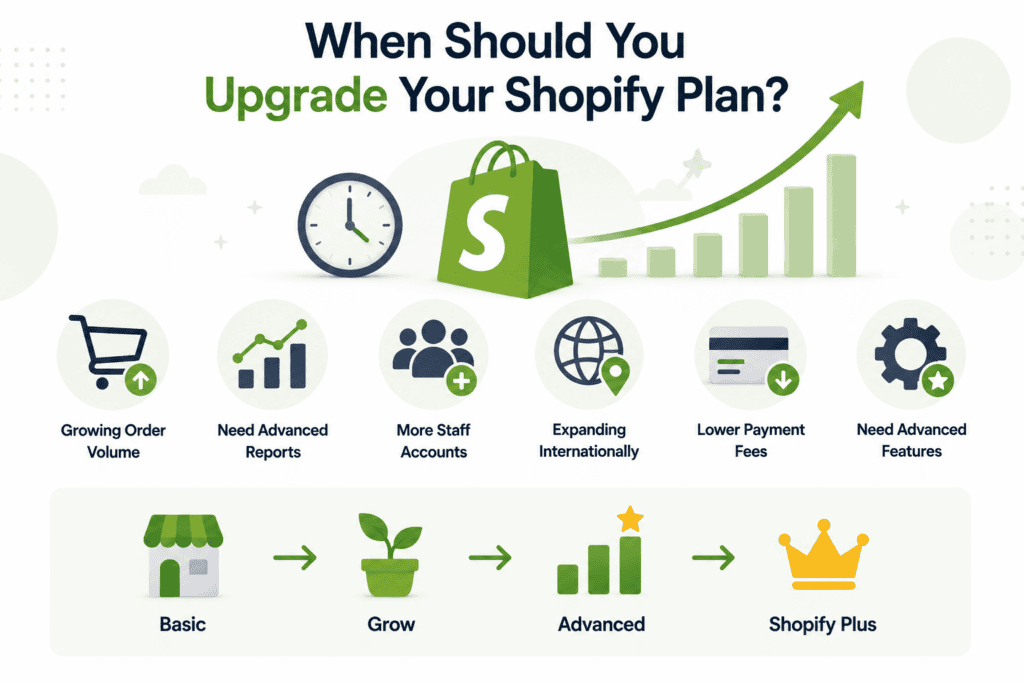
Signs it’s time to move to the next plan include:
- Your monthly order volume has increased significantly.
- You need more advanced reports and customer insights.
- You require additional staff accounts.
- You’re expanding into international markets.
- Lower payment processing rates would offset the higher subscription cost.
- You need automation tools or advanced B2B functionality.
For businesses considering Shopify Plus, it’s worth evaluating both your operational requirements and long-term growth plans before making the investment.
Conclusion: Is Shopify Plus Worth It?
For most small and medium-sized businesses, the Basic, Grow or Advanced plans provide excellent value and include everything needed to build a successful ecommerce store.
However, if you’re managing multiple brands, selling internationally, or processing a high volume of orders, Shopify Plus can deliver substantial long-term value through automation, improved scalability and enterprise-level features.
Ultimately, the right Shopify plan isn’t necessarily the cheapest it’s the one that aligns with your business goals, supports future growth and offers the best return on investment.
Whether you’re launching a new Shopify store, migrating from another platform or upgrading to Shopify Plus, working with an experienced development partner ensures you get the most from your investment.
At Kiwi Commerce, we help businesses across the UK design, develop, optimise and scale high-performing Shopify stores tailored to their unique requirements.


 Alex
Alex