
Introduction
Choosing between Shopify Plus vs BigCommerce Enterprise isn’t about picking a “better” platform in absolute terms. It’s about understanding how each one aligns with your business model, internal capabilities, and long-term plans.
Both platforms sit firmly in the enterprise ecommerce space and are trusted by global brands. However, they approach ecommerce differently. Shopify Plus focuses on simplicity, speed, and ecosystem strength, while BigCommerce Enterprise leans towards flexibility and built-in capability.
This guide offers a practical Shopify Plus vs BigCommerce features comparison, helping you make a grounded decision based on real business needs.
BigCommerce vs Shopify Plus: Overview
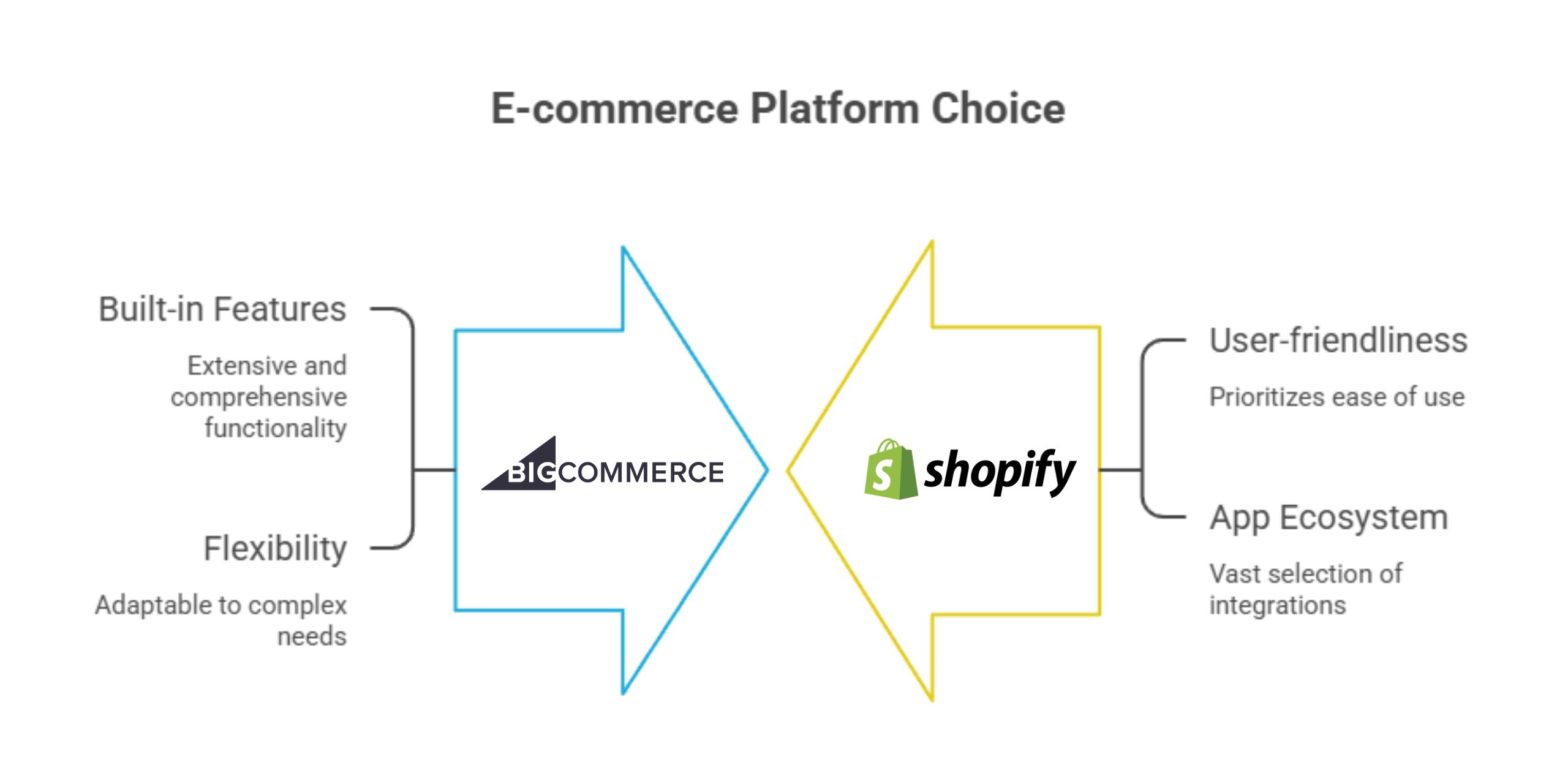 BigCommerce:
BigCommerce Enterprise is designed for businesses that want strong native functionality without heavy reliance on third-party tools.
- Built-in features reduce dependency on apps
- Flexible APIs for custom experiences
- No platform transaction fees
- Well-suited for complex catalogues and B2B setups
Shopify Plus:
Shopify Plus is widely adopted and known for its ease of use and scalability.
- Shopify Plus is more established and has a stronger ecosystem
- Shopify Plus is a very flexible platform
- Built for speed and rapid deployment
- Shopify converts better than BigCommerce in many ecommerce scenarios
Shopify Plus vs. BigCommerce: 20 Criteria to Consider
1. Initial Setup
Shopify Plus generally offers a more structured and quicker onboarding experience. BigCommerce allows more configuration upfront, which may require additional planning.
2. Ease of Use
Shopify Plus prioritises ease of use and speed to market, whereas BigCommerce Enterprise offers greater flexibility and technical control.
3. Support
Both platforms provide enterprise-level support. Shopify Plus includes a Merchant Success Manager, while BigCommerce offers dedicated account support.
4. Themes and Customisation
BigCommerce enables deeper backend customisation. Shopify Plus focuses on structured customisation through its templating system and apps.
5. Plugins and Integrations
Shopify has a larger and more mature app ecosystem. BigCommerce relies more on built-in capabilities.
6. Marketing Capabilities
Both platforms support integrations with marketing tools. Shopify tends to offer smoother plug-and-play integrations.
7. SEO Flexibility and Control
BigCommerce provides more direct control over URLs and technical SEO elements. Shopify handles SEO in a more structured way.
8. Sales Channels
Shopify supports a wide range of sales channels, including social commerce, marketplaces, and POS. BigCommerce also integrates with major channels, but with slightly less native emphasis.
9. Security and Compliance
Both platforms are fully hosted and maintain strong security standards, including PCI compliance.
10. Shipping and Fulfilment
Shopify integrates easily with fulfilment networks and third-party logistics providers. BigCommerce also supports these, but may require more configuration.
11. Inventory Management
BigCommerce offers robust native inventory handling, particularly useful for complex catalogues. Shopify often relies on apps for advanced needs.
12. Tax Calculations
Both platforms support automated tax calculations and integrations with tax services.
13. Monthly Subscription Fees
Pricing varies based on contract and scale. BigCommerce can offer more flexibility in pricing discussions, while Shopify Plus has a more standardised structure.
14. Payment Options
Shopify includes its own payment system but applies fees when using third-party gateways. BigCommerce does not charge transaction fees.
15. Total Cost of Ownership (TCO)
Shopify may involve additional app costs, while BigCommerce may require more development investment depending on complexity.
16. Time to Market
Shopify Plus is typically quicker to launch due to its structured environment. BigCommerce may take longer depending on customisation.
17. Scalability and Long-Term Support (Ecosystem Depth)
Both platforms scale effectively. In the Shopify Plus vs BigCommerce scalability comparison, Shopify’s ecosystem provides extensive third-party support, while BigCommerce offers flexibility through APIs.
18. Internationalisation and Multi-Store Management
Shopify Markets simplifies global selling. BigCommerce supports multi-store setups with more manual configuration.
19. B2B Capabilities
BigCommerce includes strong native B2B features. Shopify Plus supports B2B but often through apps or custom setups.
20. Checkout Performance and Conversion Flexibility
Shopify’s checkout is highly optimised and widely tested. BigCommerce provides flexibility but with fewer built-in optimisation tools.
Features that are Unique in BigCommerce (BigCommerce vs Shopify Plus)
- No transaction fees across payment gateways
- Native B2B functionality
- Advanced product variant handling
- Open SaaS architecture for deeper control
Features that are Unique in Shopify Plus (BigCommerce vs Shopify Plus)
- Shopify Flow for automation
- Shopify Scripts for checkout customisation
- Extensive app ecosystem
- Highly optimised checkout experience
Pros and Cons of BigCommerce
| Pros | Cons |
| Strong built-in features | Smaller app ecosystem |
| No transaction fees | Slightly steeper learning curve |
| Advanced B2B tools | Longer setup in some cases |
| Flexible APIs | UX is not as streamlined |
Pros and Cons of Shopify Plus
| Pros | Cons |
| Easy to use | Transaction fees (depending on gateway) |
| Fast to launch | Reliance on apps for some features |
| Strong ecosystem | Less backend control |
| Optimised checkout | Costs can increase with apps |
BigCommerce vs Shopify Plus: Which Platform Powers Better?
In a BigCommerce vs Shopify Plus comparison, performance and scalability depend on how the platform is implemented.
- Shopify Plus is often preferred for fast-moving D2C brands that prioritise speed and conversion
- BigCommerce Enterprise is commonly chosen by businesses needing more control and built-in functionality
Rather than one outperforming the other universally, each platform supports different operational styles.
Migrating Between Platforms
Migration becomes relevant when your current platform starts limiting growth or efficiency.
Working with a Shopify Migration Agency can help ensure:
- SEO continuity
- Clean data migration
- Reduced downtime
You may also benefit from a Shopify web development company or choose to Hire shopify Developer depending on your requirements.
After migration, Shopify Performance Optimisation can help improve speed and conversions.
Which Platform Should You Choose?
Choose Shopify if:
- You want faster deployment
- Ease of use is a priority
- You rely on integrations and apps
- You want a strong ecosystem backing your growth
Choose BigCommerce if
- You need built-in B2B functionality
- You prefer backend flexibility
- You manage complex catalogues
- You want to minimise reliance on third-party apps
Conclusion
When evaluating which is better: Shopify Plus vs Bigcommerce Enterprise, the focus should be on alignment rather than comparison alone.
Shopify Plus and BigCommerce Enterprise both support scalable, high-performing ecommerce operations. The right choice depends on how your team works, how quickly you need to move, and how much control you require.
This Shopify Plus vs BigCommerce Enterprise comparison shows that success isn’t defined by the platform itself but by how well it fits your business.

 Smith
Smith